Home Improvement
Can Multiple Air Purifiers Interfere With a Home’s Airflow Patterns?

Using multiple air purifiers can improve indoor air quality, but their effectiveness depends on more than filtration power alone. Placement, room layout, airflow patterns, and the way individual units interact all influence how quickly and evenly pollutants are removed from the air.
Airflow Air Purifiers And Room Airflow
Air purifiers create their own small circulation pattern. A fan pulls surrounding air toward the intake, moves it through the filters, and releases cleaned air through the outlet. Over time, this repeated movement helps mix room air and brings suspended particles such as dust, pollen, smoke, pet dander, and fine particulate matter into contact with the filter.
The shape of that circulation pattern depends on the purifier’s design. A unit with a top outlet may send filtered air upward and allow it to spread across the ceiling before mixing back into the room. A purifier with a forward-facing outlet may produce a more directional stream. Intake location matters too: a purifier that draws air from several sides can interact with the room differently from one that pulls air only through the back. Understanding airflow air purifiers create can help explain why different designs behave differently in the same space.
The effect is rarely uniform. Air near the purifier may cycle through the filter many times before air from a distant corner reaches it once.
Room air is already moving because of people, ceiling fans, supply vents, return vents, doors, windows, temperature differences, and appliances. The purifier becomes part of this larger airflow system. Cleaning tends to improve when its intake has access to well-mixed room air and its outlet can discharge freely into the space.
Airflow rate is especially important. A purifier that circulates too little air for the room may filter efficiently each time air passes through the machine while still taking a long time to reduce pollution throughout the whole space. This is why clean air delivery rate, room volume, and desired air changes per hour are more useful than filter efficiency alone when evaluating performance.
One useful concept is “air age,” meaning how long air remains in a particular part of a room before being replaced or mixed with cleaner air. A purifier can reduce average particle levels while some pockets of air remain older and dirtier for longer. This is why two rooms with the same dimensions and the same purifier can have very different cleanup times.
Can Multiple Air Purifiers In One Room Interfere?
They can, particularly when the units are placed close together or aimed in ways that cause their air streams to compete.
A purifier placed directly in the discharge path of another may receive a disproportionate amount of already-filtered air instead of drawing from a different part of the room.
Some airflow interaction is harmless. Air naturally mixes, and cleaned air passing through a purifier again does not damage the system. The practical concern is coverage. If several machines are circulating essentially the same air while distant parts of the room receive little movement, their combined capacity is being used inefficiently. This is an important consideration when operating multiple air purifiers in one room.
The more important issue is not whether the airflows physically collide. It is whether adding the second purifier reduces particle levels faster throughout the whole room. If PM2.5 falls quickly near both machines but remains elevated in a distant seating area, the two purifiers are not distributing their capacity effectively.
Spacing units apart usually gives each purifier access to a larger portion of the room. In irregular spaces, positioning them near different circulation paths can be especially effective.
Multiple units work best when each one contributes to a different part of the room’s circulation pattern.
Do You Need Multiple Air Purifiers?
The number of purifiers you need depends more on clean-air capacity and building layout than on the number of rooms alone. When considering multiple air purifiers in house setups, it is useful to think in terms of separate air zones rather than simply counting rooms.
Start with the amount of clean air required. A purifier’s CADR, or clean air delivery rate, indicates how quickly it can supply particle-filtered air. The required CADR increases with room volume and with the number of air changes per hour you want.
Room area alone does not answer this well. A 900-square-foot open loft may function as one large air zone, while a smaller home with several bedrooms and closed doors may behave like several separate zones. Air exchange between spaces matters as much as total square footage.
Pollution sources also matter. A home with wildfire smoke infiltration, pets, cooking emissions, renovation dust, or allergy-sensitive occupants may benefit from more filtration capacity than a similar-sized home with low particle levels.
Multiple smaller units can also provide flexibility. They can be placed near separate occupied areas or pollution sources and operated independently as conditions change.
Noise can also affect the decision. One purifier may technically provide enough clean-air delivery at its highest speed, but that capacity is irrelevant if occupants keep it on low because the fan is too loud. Two units running quietly at moderate speed can sometimes provide more usable filtration in everyday life.
You need multiple purifiers when one unit cannot provide enough clean air to the places where people are actually breathing.
When Multiple Air Purifiers In House Work Better
Multiple air purifiers are particularly useful when air does not circulate freely between different parts of the home.
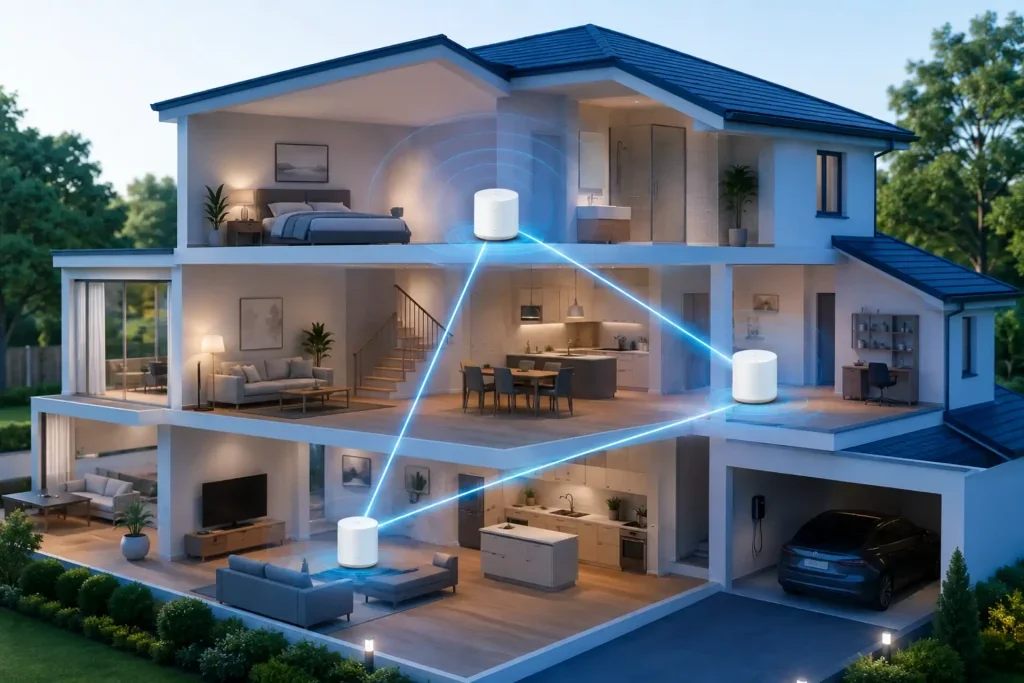
Closed bedroom doors are a common example. A powerful purifier in the living room cannot reliably clean a bedroom when little air is exchanged between the two spaces. A purifier located inside the bedroom can continuously process the air occupants are actually breathing. This is one reason multiple air purifiers in house layouts can work better than relying on one large unit.
Multi-story homes present a similar challenge because stairways, closed doors, HVAC operation, and temperature differences create distinct airflow zones. Long homes, split-level homes, upstairs-downstairs layouts, finished basements, and rooms connected through narrow hallways can behave similarly. Pollutants do not move instantly through the building, and a single central unit may clean its immediate area much faster than remote spaces.
Several units can also perform better in very large open spaces. Instead of expecting one machine to pull contaminants across a long distance, purifiers can be distributed throughout the area so particles encounter a filter sooner. This is especially useful during pollution events such as cooking, wildfire smoke infiltration, cleaning, or heavy pet activity.
They can also provide resilience. If one unit is moved, turned off, or has reduced airflow because of a loaded filter, the rest of the home still retains some filtration.
The goal is enough clean-air delivery in each meaningful air zone, rather than simply accumulating the highest total CADR in one location.
Air Purifier Placement And Performance
Placement determines how easily polluted room air reaches the purifier and how effectively cleaned air is redistributed. Good air purifier placement can therefore influence practical performance even when the purifier itself is appropriately sized.
A purifier can have an excellent filter and still clean a room slowly if its intake sits in a sheltered pocket behind a sofa, under a desk, inside a recessed corner, or next to heavy curtains. An intake pressed against a wall, sofa, curtain, or cabinet may receive less air than the fan was designed to handle.
Outlet direction matters too. A strong upward discharge can help create room-scale mixing in some spaces. A horizontal outlet pointed into open space can extend circulation farther across a room. An outlet pointed directly at a wall may shorten that circulation path.
Most units perform well when they have open space around their intake and discharge areas. The exact clearance should follow the manufacturer’s instructions because airflow designs differ.
Placement near a pollution source can be useful when the source is predictable. A purifier positioned reasonably close to an entryway may capture some outdoor particles entering the home. A unit near a pet’s main area may encounter more airborne dander. For cooking particles, filtration can supplement a vented range hood after emissions enter the room.
For general background filtration, a location that connects with normal room circulation is usually effective. The purifier should have access to the air people occupy rather than being isolated behind furniture or inside a corner with weak airflow.
The most efficient location is usually one where the purifier has unobstructed intake airflow, a clear discharge path, and good access to the room’s existing circulation.
Air Purifier Placement And Dead Zones
A dead zone is an area where air mixes slowly enough that contaminants remain longer than they do elsewhere in the room.
Dead zones often develop behind large furniture, inside alcoves, around room partitions, underneath lofts, or in sections of irregular floor plans. A purifier located far from these areas may clean the main circulation path efficiently while pollutants in poorly mixed regions decline more slowly. Adjusting air purifier placement can sometimes bring these areas into a stronger circulation path.
Short-circuiting airflow can also occur. This happens when cleaned air leaving the purifier returns quickly to its intake without circulating through much of the room. Nearby walls, furniture, or another purifier can contribute to this pattern. The machine continues filtering air, but much of its airflow is being spent on air that is already relatively clean.
Some recirculation is inevitable and completely normal because filtration is a repeated process. Efficiency falls mainly when the purifier repeatedly processes a small local air volume while other parts of the room remain weakly connected to that circulation loop.
One clue is uneven cleanup time. If PM2.5 falls rapidly beside the purifier and much more slowly across the room, the limitation may be airflow distribution rather than purifier capacity.
Moving the unit even a few feet can sometimes improve coverage substantially, especially when the original location was enclosed or obstructed.
Positioning Multiple Air Purifiers In One Room
Multiple purifiers generally work best when they serve different parts of the room.
Instead of clustering two machines together, place them far enough apart that each unit draws from a distinct region. In a long rectangular room, spacing units toward opposite ends can reduce the distance air must travel before encountering a filter. In an L-shaped room, placing one purifier in each section can help overcome the weak mixing that often occurs around the bend. This approach can make multiple air purifiers in one room more effective than concentrating them in a single area.
Avoid putting both machines in the same corner or directly beside each other unless they are intentionally serving a concentrated pollution source. That arrangement often produces overlapping airflow without much improvement in distant parts of the room.
Avoid arranging units so their outlets blow directly into one another’s intakes. It is generally more useful for filtered air to be discharged into open space so the two units contribute to broader circulation. The airflow air purifiers produce should ideally complement room-wide mixing rather than repeatedly feed one unit into another.
Placement can also follow occupancy. If one part of a large room contains a sofa and another contains a desk, positioning filtration near both breathing zones may improve exposure reduction even if the arrangement is not perfectly symmetrical.
The best arrangement can change when doors, ceiling fans, or HVAC systems are operating.
For large spaces, the goal is not equal geometric spacing. It is reducing the slowest-cleaning areas.
Room Layout And Airflow Air Purifiers
Room volume determines how much air must be processed, while layout determines how easily that air can reach each purifier.
A large room generally requires more clean-air delivery than a small one. Ceiling height matters because a 300-square-foot room with a 16-foot ceiling contains twice as much air as the same floor area with an 8-foot ceiling. Floor area alone can therefore underestimate the amount of air that needs to be cleaned.
Layout controls mixing. Open floor plans allow air to mix relatively freely. Walls, narrow hallways, closed doors, partial partitions, kitchen islands, lofts, staircases, and multiple floors can divide a home into separate circulation zones.
Furniture acts as part of that airflow architecture. Tall shelving, sofas, cabinets, curtains, large tables, and room dividers can deflect airflow or create sheltered pockets. Purifiers placed behind these obstacles may have difficulty exchanging air with the rest of the room.
HVAC systems add another layer. Supply registers push conditioned air into rooms, while return vents draw it back toward the central system. When the HVAC fan is operating, this circulation may help distribute particles toward portable purifiers. It can also carry pollutants from one area into another.
Portable purifier placement should account for these existing air streams without blocking HVAC registers or returns. In some homes, several portable units positioned within important occupied zones provide more predictable local filtration than relying on one purifier to influence air throughout the entire HVAC network. Effective air purifier placement should therefore account for both the purifier’s airflow and the home’s existing circulation.
The interaction can change throughout the day because HVAC systems cycle on and off. A purifier arrangement that performs well while the central fan is running may produce more uneven results when the system is idle.
Open and closed doors can create similarly large changes. A purifier may appear appropriately sized for one bedroom with the door closed, then effectively begin serving a much larger air volume when the door remains open to a hallway. This can also change the way airflow air purifiers generate interacts with adjacent spaces.
Is Multiple Air Purifiers In House Working?
Particle measurements provide the clearest practical feedback.
A portable PM2.5 monitor can show how quickly fine-particle concentrations fall after the purifiers are switched on. For a useful test, measure conditions before operation and then track levels over time under similar circumstances.
Measure how quickly pollution falls, not only the lowest number the sensor eventually reaches. A useful test is to track PM2.5 after a normal particle-producing event, such as cooking or outdoor smoke entering the home. Record the peak concentration, then measure how long it takes to fall by half and how long it takes to return close to the normal background level.
Placement of the monitor matters. A sensor sitting directly beside a purifier’s outlet may report unusually clean air that does not represent the entire room. Taking readings in the breathing zone and in several locations gives a better picture of overall performance.
Testing response time can reveal placement problems. If the area beside a purifier becomes clean quickly while a distant corner remains polluted for much longer, airflow distribution may be limiting performance. Moving a purifier, adding another unit, changing fan speed, or improving room mixing can then be tested and compared. Repeat the test after changing purifier placement or fan speed. A faster decline usually indicates that the new setup is delivering more effective particle removal. This type of testing is especially useful when evaluating multiple air purifiers in one room.
It is also useful to compare rooms. If one area repeatedly returns to low PM2.5 within 20 minutes while another takes an hour under similar conditions, the slower area may need better placement, more airflow, or another purifier. In homes using multiple air purifiers in house, comparing cleanup times between separate zones can reveal where additional capacity or better distribution is needed.
Watch for changes over time as well. Filters accumulate particles, and airflow may decline gradually as they load. A setup that once cleared pollution quickly may begin taking longer even when fan settings remain the same.
Remember that most consumer particle sensors measure particulate matter rather than every indoor pollutant. HEPA-style particle filtration can substantially reduce airborne particles, while gases such as carbon dioxide, radon, carbon monoxide, and many volatile organic compounds require different monitoring and control strategies.
A well-designed setup ultimately combines adequate clean-air delivery with good distribution. The purifiers need enough capacity for the space, and the room’s airflow needs to give contaminated air a reasonable path toward those filters. The most useful sign of a good setup is consistent, reasonably fast particle reduction across the places where people spend time, rather than an excellent reading at only one sensor location.
University of Houston graduate with 5 years of blogging experience, excelling in content strategy, SEO, and audience engagement. Connect with me on LinkedIn.