
HEALTH
The Critical Role of Compliance in Country-Specific Labeling for Medical Products


Introduction
Navigating the complex landscape of medical product regulations requires manufacturers to meet unique labeling standards set forth by each country. These country-specific demands are implemented to ensure patient safety, facilitate understanding among healthcare providers, and expedite regulatory approvals. The consequences of falling short in this area can be significant, leading to denied market access and undermining public health initiatives. Staying on top of Country Specific Labeling challenges is not just a regulatory checkbox—it’s a critical component of international success in the medical device and pharmaceutical sectors.
Proper labeling not only serves to inform patients and practitioners about the safe and effective use of products but also builds trust in both manufacturers and local regulatory agencies. As global trade expands, companies must adapt quickly to disparate frameworks, knowing that enforcement agencies diligently monitor and penalize non-compliance. In short, labeling that is both accurate and adheres to local standards is foundational for both patient safety and business continuity.
Understanding Country-Specific Labeling Requirements
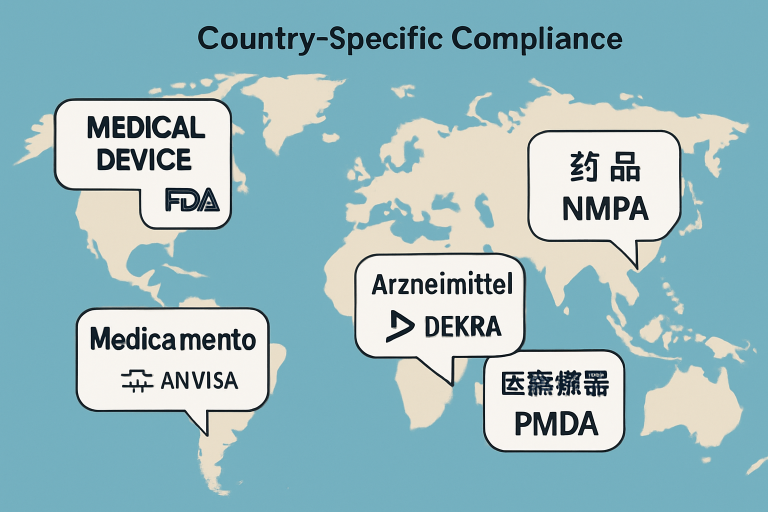
No two nations share identical expectations for medical product labeling. For instance, the European Union requires the inclusion of standardized symbols for traceability, safety warnings, and instructions for use under the Medical Devices Regulation (MDR). Meanwhile, the United States, through the Food and Drug Administration (FDA), mandates informational clarity about ingredients, usage, manufacturer details, and stringent pharmacovigilance data. The diversity expands further in regions like Asia-Pacific, Latin America, and Africa, where language, cultural specifics, and technical details demand customized label creation and rigorous approvals.
Compliance is not simply a matter of translation, but a careful synthesis of regulatory, cultural, and medical nuances. Local guidance often dictates specifics from font size and layout to color coding and mandatory safety symbols. Organizations must maintain robust regulatory intelligence to prevent labeling errors that could delay product releases or, worse, jeopardize patient safety.
Challenges in Achieving Compliance
- Regulatory Variability: Medical product manufacturers face frequent regulatory shifts and divergent enforcement standards worldwide, which complicates their compliance journey.
- Language Barriers: Merely translating language is insufficient—labels must be culturally and contextually accurate to meet patient needs and regulatory language mandates.
- Frequent Updates: Regulators revise labeling standards in response to scientific advancements, incidents of misuse, or shifting political priorities, making it essential to track and quickly adapt to changes.
Because the stakes are so high, teams need significant resources to monitor the evolving landscape continuously. Local misinterpretations or overlooked nuances have real-world consequences, ranging from product recalls to legal action.
Strategies for Effective Compliance
- Implement Robust Quality Management Systems (QMS): Instituting an internationally recognized QMS, such as ISO 13485:2016, harmonizes quality and compliance efforts across global operations. These frameworks provide standard operating procedures and documentation controls that are auditable and compliant with regulatory requirements.
- Utilize Technology: Digital labeling platforms and regulatory management systems empower companies to manage updates, translate content, and achieve instant version control with minimal manual intervention. Leveraging such tools lowers the risk of human error and accelerates response times to changes.
- Engage Regulatory Experts: Whether in-house or through advisory partnerships, dedicated regulatory professionals interpret new rules, facilitate cross-market launches, and provide informed solutions to intricate legal questions. Their expertise is invaluable for maintaining persistent oversight and refining strategy.
Case Study: The Impact of Non-Compliance
The real-world risks of inadequate compliance are highlighted by a study from a Sri Lankan hospital, which found that 40% of surveyed medicine labels failed to meet national guidelines. Such shortcomings led to dangerous misunderstandings and mishandling of medication by staff, with direct safety consequences for patients. The study’s findings reinforce the necessity of vigilance and systematic auditing for all medical labels, at every stage of the product lifecycle.
The Role of AI in Compliance
Artificial Intelligence (AI) is revolutionizing the compliance landscape for medical product labeling. Machine learning-powered solutions provide automated translation, real-time monitoring of regulatory changes, context-aware data extraction, and even predictive analytics to identify future trends in global labeling requirements. AI-driven labeling systems can quickly adapt product information for multiple jurisdictions, reducing turnaround times and human workload. Current implementations already demonstrate significant reductions in compliance-related recalls and accelerate global time to market.
Conclusion
As the medical device and pharmaceutical markets continue to globalize, success hinges on a company’s ability to master country-specific labeling. This means deploying agile strategies, investing in technology and compliance talent, and anchoring processes in internationally recognized management frameworks. By doing so, manufacturers ensure market access, patient safety, and regulatory confidence—essentials that secure both lives and livelihoods in the fast-evolving world of healthcare.