NEWS
Tax-Aware Investing Strategies for Better After-Tax Returns

Key Takeaways
- Tax-aware investing helps maximize after-tax returns by minimizing unnecessary tax liabilities.
- Asset location, tax-loss harvesting, tax-advantaged accounts, and tax-efficient investments are foundational strategies for improving tax efficiency in your portfolio.
- Regular portfolio review and consultation with financial advisors foster optimal results and ongoing compliance with tax laws.
Understanding Tax-Aware Investing
Achieving higher investment returns is often about more than just picking the right stocks or funds. Tax-aware investing focuses on strategies that reduce your overall tax liabilities, allowing you to keep more of what your investments earn. Integrating tax-smart tactics into your financial plan can make a significant difference over time, especially as compounding works on your growing after-tax capital.
Many investors focus solely on growth potential, failing to account for how taxes can erode returns. Learning how to rebalance your investment portfolio is a key part of this process, ensuring that your asset allocation remains aligned with your goals while optimizing tax efficiency. This is why it is crucial to understand how rebalancing and asset location can work together for more efficient portfolio management.
Tax-aware investing looks at the “real” return after taxes are paid. Investment income, capital gains, and dividends may be taxed differently, depending on your account types and holdings. Building your investing approach around these realities can help create a smoother journey toward your financial goals.
Taking a methodical approach, starting with the types of accounts you use, followed by smart asset allocation and active tax-loss harvesting, puts you on a solid footing for tax efficiency. Incorporating tax-advantaged investments and periodic assessments aligns your tactics with evolving tax laws and your changing financial picture.

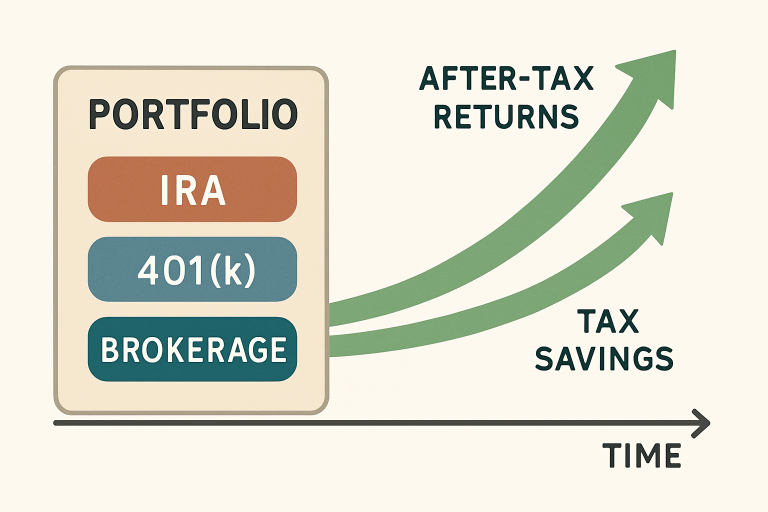
Key Strategies for Tax Efficiency
1. Asset Location
The account in which you hold an investment can make a significant difference in your overall tax burden. Tax-inefficient investments, such as high-turnover mutual funds or taxable bonds, are best placed in tax-deferred or tax-advantaged accounts such as IRAs or 401(k)s. This placement helps shelter income from immediate taxation, allowing that portion of your portfolio to grow unhindered until you begin withdrawals. Conversely, tax-efficient investments, such as index funds and municipal bonds, are usually better suited for regular brokerage accounts because they generate less taxable income.
By practicing thoughtful asset location, you ensure that income-producing assets are strategically held in accounts that minimize tax drag.
2. Tax-Loss Harvesting
Tax-loss harvesting involves selling investments at a loss to offset gains from the sale of other assets. This not only reduces your taxable income but also creates an opportunity to reinvest in similar assets, maintaining your market exposure. Regularly harvesting losses can be particularly useful during volatile markets, providing a buffer when rebalancing your portfolio.
The effectiveness of tax-loss harvesting is most apparent when coordinated with year-end tax planning or after significant market fluctuations. Utilizing this strategy annually, or even opportunistically, can have a profound impact on your tax picture and strengthen your after-tax wealth.
3. Utilizing Tax-Advantaged Accounts
Maximizing contributions to accounts like Health Savings Accounts (HSAs), 401(k)s, Roth IRAs, or 529 college savings plans is another pillar of tax-aware investing. HSAs are especially attractive for those enrolled in high-deductible health plans, offering tax-deductible contributions, tax-free investment growth, and tax-free withdrawals for qualified medical expenses. Over time, the triple tax advantage can add flexibility and compound tax savings, enhancing long-term wealth accumulation.
In addition, 529 plans allow for tax-free growth if funds are used for educational expenses, while Roth IRAs provide tax-free withdrawals in retirement, potentially benefiting those expecting higher tax rates in the future.
4. Choosing Tax-Efficient Investments
The type of assets you choose also affects your overall tax exposure. Index mutual funds and exchange-traded funds (ETFs) are typically more tax-efficient than actively managed funds because of their lower turnover, which results in fewer capital gains distributions. Municipal bonds can offer tax-free income at the federal or even state level for some investors.
Building your core portfolio with these vehicles helps minimize your annual taxable events. Keeping an eye on internal fund structures and their tendency to distribute capital gains lets investors proactively select funds that consistently maintain a tax-conscious approach.
Implementing Tax-Aware Strategies
Implementing tax-aware strategies requires ongoing oversight and discipline. Start with these key steps:
- Regularly review your investments and rebalance them, ensuring your holdings remain optimally positioned from a tax perspective.
- Work with a financial or tax advisor to personalize these strategies to your unique objectives and tax bracket.
- Stay up to date with changing tax legislation, which may create new opportunities or require a shift in tactics to maintain tax efficiency.
Awareness and adaptability are essential as tax laws and your own situation change over time.
Final Thoughts
Tax-aware investing is not just about maximizing gross returns; it is about systematically enhancing what you actually keep after taxes. Employing asset location, tax-loss harvesting, utilizing tax-advantaged accounts, and selecting tax-efficient investments form the backbone of a prudent after-tax wealth strategy. With attention to detail and periodic rebalancing, you can efficiently meet your financial objectives while minimizing surprises come tax season.

