
Latest News
Pre-Sales FAQ for Linux Screen Recording Software Explained

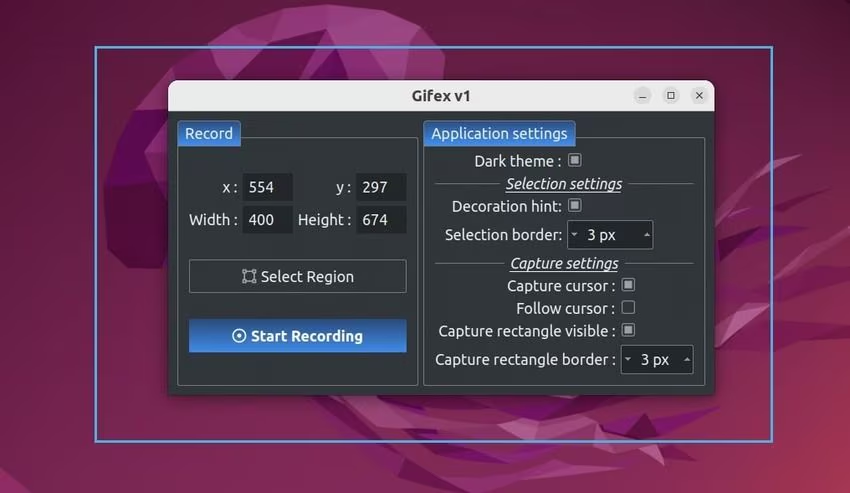
Screen recording on Linux has never been more relevant. Whether you’re a developer creating software tutorials, a gamer capturing epic gameplay moments, or a professional documenting workflows, having the right screen recording tool can make or break your productivity. Linux users, however, face a unique challenge: the ecosystem is fragmented, and not every tool delivers on its promises across different distributions and hardware configurations.
This uncertainty often leads to hesitation at the point of purchase. Questions pile up fast — Does this software work on my distro? What happens if it crashes after I buy it? Is there real support available, or will I be left troubleshooting alone? These are legitimate concerns, and without clear answers, many users either delay their purchase or end up with software that doesn’t meet their needs.
This guide is designed to change that. By walking through the most common pre-sales questions around product warranty, customer service, shipping fees, and feature compatibility, you’ll gain the clarity needed to make a confident, informed purchase decision. Think of it as your complete pre-sales FAQ companion for screen recording software Linux — one that cuts through the noise and gives you exactly what you need to buy smart.
Why Pre-Sales Information Matters for Linux Screen Recording Tools
Buying screen recording software without doing your homework first is a gamble — especially on Linux. Unlike Windows or macOS, Linux encompasses hundreds of distributions, each with its own kernel version, desktop environment, and dependency structure. A tool that runs flawlessly on Ubuntu 22.04 might refuse to launch on Fedora 38 or Arch Linux. This is why pre-sales research isn’t just helpful; it’s essential for avoiding costly mistakes and wasted time.
Pre-sales FAQs exist precisely to close the gap between marketing claims and real-world performance. They answer the questions that product pages often gloss over — which distributions are officially supported, whether Wayland is compatible alongside X11, what happens if a major update breaks functionality, and whether refunds are available if the software doesn’t work as advertised. For Linux users especially, these details can mean the difference between a tool that integrates seamlessly into their workflow and one that collects digital dust.
Beyond compatibility, pre-sales information builds trust. When a software vendor proactively publishes clear answers about warranty terms, support channels, and system requirements, it signals transparency and confidence in their product. Customers who feel informed before purchasing are far more likely to be satisfied after the fact. Skipping this step often leads to frustration, refund requests, and negative reviews — outcomes that benefit no one. Taking fifteen minutes to review pre-sales documentation before clicking “buy” is one of the smartest investments a Linux user can make. This principle applies broadly across tech purchases — hardware vendors like PEMP Car Audio, for instance, follow a similar philosophy by publishing detailed compatibility and support documentation before customers commit to a purchase.
Clarifying Product Warranty Terms for Linux Screen Recording Software
One of the most overlooked aspects of buying software is understanding what the product warranty actually covers. For Linux screen recording tools, this matters more than you might expect. A warranty isn’t just a legal formality — it’s your safety net if the software fails to deliver after purchase. Before committing to any tool, take time to review the warranty terms carefully, since they vary significantly between vendors.
What is Typically Covered Under Warranty?
Most software warranties cover functional defects — situations where the program fails to perform as advertised through no fault of your own. This typically includes critical bug fixes, patches for crashes or data loss issues, and access to major version updates within a defined period. Some vendors extend warranty coverage to include basic technical support for installation and configuration problems. What’s generally excluded is equally important to understand: issues caused by incompatible third-party plugins, unsupported Linux distributions, or user-modified system configurations usually fall outside warranty scope. Hardware-related recording failures, such as problems stemming from your GPU or audio drivers, are also commonly excluded. Always read the fine print to distinguish between what’s guaranteed and what’s simply hoped for.
How to Claim Warranty and What Documentation is Needed?
Claiming a warranty is straightforward when you’re prepared. Start by contacting the vendor’s customer service through their official support channel — email or a dedicated support portal are the most common routes. You’ll need your proof of purchase (an order confirmation email works perfectly), the software license key, and a clear description of the issue including your Linux distribution, kernel version, and steps to reproduce the problem. Screenshots or error logs significantly strengthen your case and speed up resolution. Most vendors process warranty claims within three to five business days, though response times vary. The single most important habit to develop: keep all purchase records in a dedicated folder immediately after buying. Losing your license key or order confirmation can delay or even invalidate a legitimate warranty claim entirely.
Evaluating Customer Service and Support Before You Buy
Great software can still become a frustrating experience if the customer service behind it falls short. Before purchasing any Linux screen recording tool, evaluating the quality and availability of support is just as important as checking feature lists. Linux environments are inherently diverse, and even well-built software occasionally needs troubleshooting — having responsive, knowledgeable support can save hours of headache down the line.
Types of Customer Support Available
Support structures vary widely between vendors. Premium tools typically offer email support, live chat, and access to a structured knowledge base with guides tailored to common Linux issues. Some vendors maintain active community forums where experienced users and developers collaborate to solve problems — particularly valuable for Linux-specific edge cases involving Wayland compositors, PipeWire audio, or niche hardware configurations. Free or open-source tools often rely entirely on community-driven support through platforms like GitHub or Reddit, which can be excellent but unpredictable in response time. When evaluating a tool, prioritize vendors who offer at least one direct support channel alongside community resources.
How to Access Support and Expected Response Times
Before buying, test the support channel yourself. Send a pre-sales question through the vendor’s official contact form or live chat — something specific, like asking whether the software supports OBS-compatible plugins on Ubuntu 24.04 with Wayland. A vendor who responds clearly within 24 to 48 hours demonstrates reliability. Live chat typically yields same-day responses, while email support averages one to three business days. When reaching out, have your system details ready: distribution name, version, desktop environment, and GPU model. This habit not only gets you faster answers pre-purchase but also prepares you for any post-purchase support interactions that may follow.
Understanding Shipping Fees and Delivery for Software Purchases
When purchasing Linux screen recording software, the concept of shipping fees might seem irrelevant — after all, software is digital. But the reality is more nuanced. While most vendors deliver software instantly via digital download at no additional cost, some offer optional physical media packages (DVDs or USB drives) for users who prefer offline installation or want a backup copy. These physical options typically carry shipping fees that vary by region and delivery speed, with international orders often incurring higher charges. Additionally, certain premium support packages or bundled hardware accessories may also trigger shipping costs at checkout. To avoid surprises, always review the order summary page before completing your purchase. Look for a dedicated shipping or delivery section that itemizes any applicable fees. If you’re purchasing a purely digital license, confirm that no physical shipment is attached to your order. When in doubt, contact the vendor directly to clarify what’s included — a quick pre-purchase email can save you from unexpected charges appearing on your final invoice.
Comprehensive Guide to Pre-Sales FAQs for Linux Screen Recording Software
A well-organized pre-sales FAQ is arguably the most valuable resource a software vendor can offer — and for Linux screen recording tools, it’s practically indispensable. Unlike generic product descriptions, a thorough pre-sales FAQ anticipates the specific doubts that hold potential buyers back and addresses them directly. Knowing where to find these resources and how to use them effectively can dramatically shorten your decision-making process while reducing the risk of a disappointing purchase.
Start with the vendor’s official website. Most reputable software companies maintain a dedicated FAQ or Help Center section, often accessible from the footer navigation or the product page itself. If a vendor doesn’t publish any pre-sales documentation, treat that as a red flag. Next, cross-reference what you find with independent user feedback on platforms like Reddit’s r/linux community, DistroWatch forums, or software review sites such as AlternativeTo and G2. Real-world user experiences frequently surface compatibility issues or support gaps that official FAQs conveniently omit. Finally, compare at least two or three competing tools side by side — not just on features, but on the quality and depth of their pre-sales information. A vendor who invests in transparent documentation is far more likely to back their product with genuine post-purchase support.
Common Questions About Software Compatibility and Features
The most critical pre-sales questions center on compatibility and recording capabilities. Which Linux distributions are officially supported — and is that list actively maintained? Does the software run on both X11 and Wayland, or only one? What are the minimum hardware requirements for smooth 1080p or 4K capture? Does it support GPU-accelerated encoding via NVENC or VAAPI? Can it capture system audio through PipeWire or PulseAudio simultaneously with microphone input? Are webcam overlays, scheduled recordings, or region-specific capture supported? These questions aren’t trivial — they determine whether the software actually fits your workflow before you spend a single dollar.
How to Use Pre-Sales FAQs to Make an Informed Decision
Approach pre-sales FAQs strategically rather than skimming them passively. First, list your three non-negotiable requirements — for example, Wayland support, lossless output format, and multi-track audio recording. Then scan the FAQ specifically for answers to those priorities. If the FAQ is silent on any of them, don’t assume the feature exists — contact the sales team directly with a pointed question and evaluate the quality of their response. Cross-reference vendor answers with community feedback to spot discrepancies. If users consistently report that a “supported” feature is buggy or incomplete, weigh that heavily. Treat the FAQ as a starting point for investigation, not a final verdict, and you’ll walk into your purchase with genuine confidence rather than wishful thinking.
Buy Smarter: Your Pre-Sales Checklist for Linux Screen Recording
Navigating the pre-sales landscape for Linux screen recording software doesn’t have to be overwhelming. By taking the time to review warranty terms, you protect your investment and ensure you have a clear path to resolution if something goes wrong after purchase. Evaluating customer service quality before you buy gives you a realistic picture of the support you’ll receive when you need it most — and on Linux, that support can make a genuine difference. Understanding shipping fees, even for digital products, helps you avoid unexpected charges and confirms exactly what you’re getting at checkout. And making full use of pre-sales FAQs transforms guesswork into confident, criteria-driven decision-making.
The common thread running through all of these steps is preparation. Linux users who invest a small amount of time researching before purchasing consistently end up with tools that fit their workflow, their distribution, and their expectations. Rather than discovering limitations after the fact, you’ll already know what you’re getting — and why it’s the right choice. Apply the insights from this guide the next time you evaluate a Linux screen recording tool, and you’ll approach that purchase with the clarity and confidence every buyer deserves.