Lifestyle
FOMO: What It Means, Causes, Signs, Effects, and How to Overcome It

What Is FOMO?
FOMO stands for Fear of Missing Out. It describes the feeling that other people are enjoying better experiences, opportunities, events, or connections while you are missing them.
A person experiencing FOMO may worry that friends are having fun without them, other people are getting better opportunities, or an important event is happening while they are somewhere else.
FOMO is especially common in the age of social media because people can see updates from friends, celebrities, influencers, coworkers, and strangers almost instantly. A person may open Instagram, TikTok, Facebook, Snapchat, or another platform and see photos of a party, vacation, concert, new job, expensive purchase, or social gathering.
Even when someone was perfectly happy a few minutes earlier, seeing those posts can create the feeling that they are missing something important.
Researchers generally describe FOMO as apprehension that other people are having rewarding experiences while you are absent, along with a desire to remain connected to what others are doing.
FOMO is not limited to social media. It can happen at school, at work, in relationships, during travel, when shopping, and when making everyday decisions.
What Does FOMO Mean?
The simple meaning of FOMO is:
Fear of missing out on something that other people are experiencing.
For example, imagine that your friends go to a restaurant without you. Later, you see pictures of the group laughing together.
You may start thinking:
- “I wish I had gone.”
- “Maybe they had an amazing time.”
- “Why wasn’t I invited?”
- “Are they becoming closer without me?”
- “Did I miss something important?”
Those thoughts can create anxiety or disappointment.
FOMO can also happen when the event itself is not particularly important. Someone might skip a party because they are tired, but after seeing pictures from the party, they may suddenly regret staying home.
Recent research suggests that FOMO can involve more than simply wanting to attend a fun event. People can also worry that missing a group activity could weaken their relationships or make them feel excluded.
How Did the Term FOMO Become Popular?
The idea behind FOMO is older than social media, but the term became widely recognized during the growth of social networking.
Research into FOMO increased during the early 2010s as smartphones and social networking services made it much easier for people to constantly see what others were doing.
Before smartphones, a person might hear about a party or event after it happened. Today, someone can watch updates while an event is still happening.
This creates a major difference.
A person sitting at home can see:
- Friends eating at a restaurant
- People attending concerts
- Coworkers traveling
- Influencers attending events
- Someone buying a new car
- Friends celebrating birthdays
- People announcing new jobs
- Couples sharing vacations
- People showing expensive purchases
Constant access to these updates can make it difficult to feel completely disconnected from other people’s activities.
Why Do People Experience FOMO?
There is no single reason why someone experiences FOMO. Different people can experience it for different reasons.
However, several factors can make the feeling stronger.
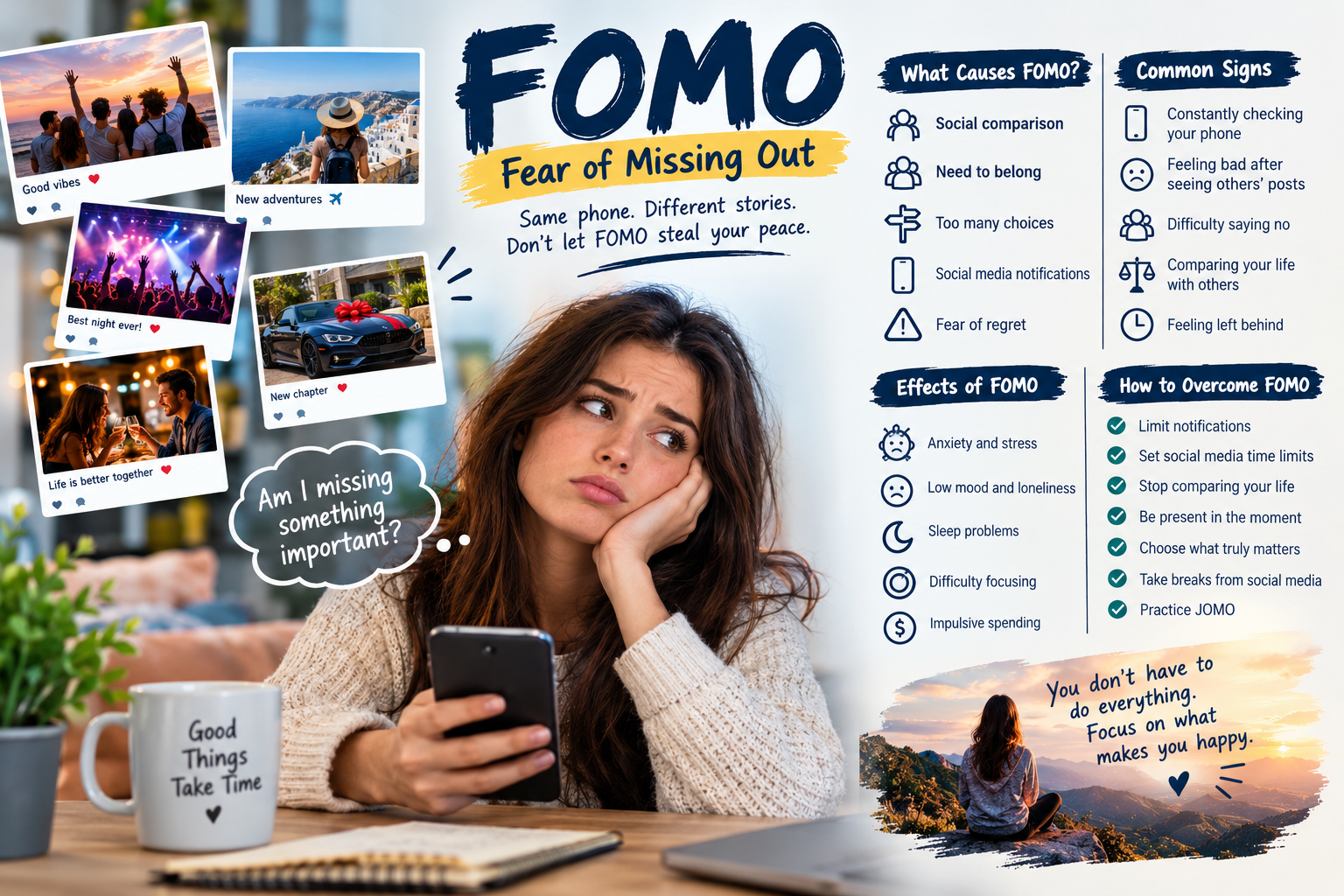
1. Social Comparison
People naturally compare themselves with others.
Social media makes this process easier because users can quickly compare their relationships, appearance, careers, income, vacations, homes, hobbies, and lifestyles with other people’s posts.
The problem is that social media usually shows selected moments rather than someone’s complete life.
A person might post a picture from a great vacation but never show the stressful travel delays, expensive bills, arguments, or boring moments.
As a result, you may compare your ordinary day with someone else’s best moment.
2. The Need to Belong
People generally want to feel accepted and connected to others.
When someone believes that friends or social groups are doing something without them, they may worry about their position within the group.
Research has connected FOMO with the need for social connection and belonging.
This helps explain why missing a social event can sometimes feel much more serious than simply missing an activity.
The concern may actually be:
“Will I still be part of this group?”
3. Too Many Choices
Modern life gives people a huge number of choices.
You can choose between:
- Hundreds of movies
- Thousands of restaurants
- Different careers
- Travel destinations
- Online courses
- Social events
- Hobbies
- Apps
- Games
- Products
- Investment opportunities
Having many choices can be useful, but it can also create anxiety.
You may wonder whether another option would have been better.
This can turn an ordinary decision into a source of regret.
4. Social Media Notifications
Notifications can make FOMO stronger.
A phone may constantly tell you:
- Someone posted a story
- Someone sent a message
- Someone went live
- A friend uploaded a photo
- A group conversation is active
- A new video is trending
Every notification can create a small reason to check your phone.
Research has found that FOMO can encourage frequent checking of social networks and messaging services because staying connected can temporarily reduce the uncomfortable feeling of being out of the loop.
5. Fear of Regret
Sometimes FOMO is really a fear of making the wrong decision.
For example, you might be invited to two events.
You choose Event A but spend the evening wondering what is happening at Event B.
You may have enjoyed Event A, yet still feel dissatisfied because you cannot know what you missed.
This is one reason FOMO can make even good decisions feel disappointing.
Common Signs of FOMO
FOMO can appear differently from one person to another.
Some common signs include:
Constantly Checking Your Phone
You repeatedly check social media, messages, or notifications even when you have no specific reason to do so.
Feeling Bad After Seeing Other People’s Posts
You feel disappointed, lonely, jealous, or anxious after seeing friends or strangers enjoying themselves.
Difficulty Saying No
You accept invitations even when you are tired or do not actually want to attend because you are afraid of missing something.
Comparing Your Life With Others
You frequently compare your career, relationships, appearance, possessions, or lifestyle with other people.
Feeling Left Behind
You believe that everyone else is progressing while you are staying in the same place.
Checking What Others Are Doing
You regularly look at stories, posts, status updates, or group chats to make sure you are not missing important information.
Regretting Your Decisions
After choosing one activity, you spend time thinking about the alternatives you rejected.
Difficulty Enjoying the Present
You may be at dinner, watching a movie, working, or spending time with family while thinking about what everyone else is doing.
FOMO and Social Media
Social media and FOMO are closely connected, although FOMO existed before social networks became popular.
Social platforms provide a constant stream of information about other people’s activities.
This can create a cycle:
See what others are doing → feel like you are missing something → check social media → discover more activities → feel FOMO again.
For some people, this becomes a repeated habit.
A systematic review and meta-analysis covering 55,134 participants found a significant relationship between trait FOMO and internet use, although the strength of that relationship varied considerably between studies and populations.
This is important because it shows that FOMO and internet use are connected, but the relationship is not identical for everyone.
How Social Media Can Make FOMO Worse
Social media platforms are designed to keep users engaged.
Users can continuously scroll through new content. There is almost always another video, photo, message, story, or recommendation waiting.
This creates an environment where people can remain aware of activities happening outside their immediate surroundings.
For someone already worried about missing out, this constant stream of information can make the feeling stronger.
The Highlight Reel Problem
One of the biggest issues is that people usually post their highlights.
Someone may share:
- A perfect vacation photo
- A new house
- A successful business launch
- A wedding
- A birthday celebration
- A new car
- A promotion
- A night out with friends
They usually do not post every ordinary or difficult moment.
This can create a distorted comparison.
You see their best moments while experiencing your entire life.
Examples of FOMO
FOMO can appear in many parts of life.
Social FOMO
Your friends go out without you and post pictures online.
You start feeling that you should have gone.
Travel FOMO
You see people visiting beautiful destinations and begin feeling that your own life is boring because you are not traveling.
Career FOMO
You see someone your age announcing a promotion or successful business.
You begin wondering whether you are falling behind.
Shopping FOMO
A website says a product is available for a limited time.
You buy it because you are afraid the opportunity will disappear.
Investment FOMO
You hear that an asset has increased significantly in price.
You feel pressure to buy because you are afraid that you will miss future gains.
This type of FOMO can be particularly risky because emotional decisions involving money can lead to losses.
Relationship FOMO
You see couples posting romantic pictures online and begin questioning your own relationship status.
Academic FOMO
A student sees classmates taking additional courses, joining organizations, or receiving awards.
They begin feeling that they are not doing enough.
What Is FOMO in Marketing?
FOMO is also widely used in marketing.
Businesses sometimes create urgency by suggesting that customers may miss an opportunity if they do not act quickly.
Examples include:
- “Sale ends tonight.”
- “Only a few left.”
- “Limited time offer.”
- “Early bird pricing.”
- “Last chance.”
- “Offer expires soon.”
This is sometimes called FOMO marketing.
The basic idea is simple: people may act faster when they believe an opportunity will disappear.
However, businesses should use urgency honestly. Fake scarcity or misleading countdowns can damage customer trust.
FOMO in Cryptocurrency and Investing
FOMO is particularly common in financial markets.
Imagine that a cryptocurrency suddenly rises by 50%.
People begin posting about it online.
News spreads quickly.
You see screenshots of large profits.
You start thinking:
“If I don’t buy now, I will miss the next big move.”
That emotional pressure can lead someone to make a decision without properly researching the asset.
The same thing can happen with stocks, collectibles, real estate, or other investments.
FOMO can cause people to buy after prices have already increased significantly because they are afraid of missing future gains.
A better approach is to make financial decisions based on a clear strategy, risk tolerance, research, and a time horizon rather than pressure from social media.
FOMO vs JOMO
An interesting opposite of FOMO is JOMO, which means Joy of Missing Out.
FOMO says:
“Everyone is doing something. I should be there too.”
JOMO says:
“I don’t need to participate in everything. I can enjoy what I am doing right now.”
For example, imagine your friends are going to a party.
With FOMO, you might feel pressured to attend even when you are exhausted.
With JOMO, you might stay home, relax, read a book, watch a movie, or spend time with family without feeling guilty.
JOMO is not about avoiding people or refusing every invitation.
It is about becoming comfortable with choosing what actually matters to you.
How to Overcome FOMO
FOMO may not disappear completely, but you can learn to manage it.
1. Reduce Unnecessary Notifications
Turn off notifications that are not important.
You do not need your phone to interrupt you every time someone posts something.
Reducing notifications can create more space between you and social media.
2. Set Social Media Limits
Choose specific times to check social platforms.
Instead of opening an app every few minutes, you could check it during selected periods of the day.
The goal is to make social media something you choose to use rather than something that automatically controls your attention.
3. Stop Comparing Your Entire Life
Remember that other people’s social media feeds are incomplete.
You see their selected posts.
You do not see every problem they experience.
When you compare yourself with someone online, ask:
“Am I comparing my real life with their highlight reel?”
That question can help put the comparison into perspective.
4. Ask Yourself What You Actually Want
When you feel FOMO, pause before taking action.
Ask:
“Do I really want this, or am I afraid of missing it?”
This simple question can help separate your own preferences from outside pressure.
5. Practice Being Present
If you are having dinner with your family, focus on dinner.
If you are watching a movie, watch the movie.
If you are spending time with friends, enjoy the conversation.
Constantly wondering what you might be missing prevents you from fully experiencing what you already have.
6. Accept That You Cannot Do Everything
This is one of the most important lessons.
You cannot attend every party.
You cannot visit every country.
You cannot watch every movie.
You cannot take every opportunity.
You cannot follow every trend.
You cannot know everything happening online.
Missing some things is unavoidable.
Once you accept this, many decisions become easier.
7. Keep a Record of Good Experiences
Instead of constantly looking at what other people are doing, pay attention to your own experiences.
You can keep a journal or simply make a mental note of things you enjoyed.
This shifts your attention from:
“What am I missing?”
to:
“What am I enjoying?”
8. Take Breaks From Social Media
A short break can help you understand how strongly social media affects your mood and attention.
You do not necessarily need to delete every account.
Even a scheduled break from social media can give you more time to focus on offline activities.
Research into interventions for FOMO has explored both behavioral strategies and technology features designed to help people manage compulsive checking.
Is FOMO Always Bad?
No.
A small amount of FOMO can sometimes motivate people to participate in activities they genuinely value.
For example, you may hear that your friends are planning a weekend trip and realize that you actually want to join them.
That is not necessarily a problem.
The issue begins when fear controls your decisions.
FOMO becomes more concerning when someone:
- Constantly checks social media
- Cannot relax without checking updates
- Makes decisions mainly because of social pressure
- Experiences significant anxiety about missing events
- Neglects work or school
- Loses sleep because of online activity
- Spends money impulsively
- Has difficulty enjoying offline experiences
Research has linked problematic FOMO experiences with issues such as sleep disruption, concentration problems, anxiety, and problematic social media use.
FOMO and Mental Wellbeing
FOMO is not a medical diagnosis by itself.
It is better understood as a psychological experience that can range from an occasional feeling to a persistent pattern of worry and checking behavior.
Research has found connections between FOMO, problematic technology use, negative emotional experiences, and social media engagement. However, the relationships are complex, and FOMO does not affect everyone in exactly the same way.
If feelings of anxiety, loneliness, low mood, or compulsive behavior become severe or interfere with everyday life, speaking with a qualified mental health professional can be helpful.
How to Know If You Have Too Much FOMO
Ask yourself these questions:
- Do I check social media even when I do not have a reason?
- Do other people’s posts regularly make me feel bad about my life?
- Do I attend events mainly because I am afraid of missing them?
- Do I worry about what friends are doing when I am not there?
- Do I find it difficult to put my phone away?
- Do I compare my life with people online?
- Do I regret decisions because I imagine another option was better?
- Do I have trouble enjoying the present because I am thinking about other possibilities?
If several answers are yes, it may be useful to examine how social media, comparison, and fear of missing opportunities affect your daily life.
Frequently Asked Questions About FOMO
What does FOMO stand for?
FOMO stands for Fear of Missing Out.
It describes the worry that other people are experiencing something rewarding while you are not participating.
What is an example of FOMO?
Seeing pictures of your friends at a party and feeling anxious or disappointed because you were not there is a common example of FOMO.
Is FOMO a mental illness?
FOMO itself is not generally considered a mental illness or formal psychiatric diagnosis. It is a psychological experience that can sometimes contribute to problematic behaviors or emotional distress.
Why is FOMO common on social media?
Social media provides constant access to information about other people’s activities. This can make it easier to notice experiences you are not participating in and can encourage repeated checking.
What is the opposite of FOMO?
The commonly used opposite term is JOMO, or Joy of Missing Out. It describes being comfortable with choosing your own activities instead of feeling pressured to participate in everything.
How can I stop FOMO?
You can reduce FOMO by limiting unnecessary notifications, reducing social media use, avoiding constant comparison, practicing present moment attention, and accepting that it is impossible to participate in everything.
Can FOMO affect sleep?
Yes. Research has associated problematic FOMO and social media behavior with sleep disruption and other negative experiences.
Can FOMO affect work or school?
It can. Constant checking and concern about what others are doing can distract people from tasks. Research has examined connections between FOMO, social media use, and academic performance, particularly among students.
Is FOMO only caused by social media?
No. FOMO can happen offline as well. Someone can experience it when choosing between parties, career opportunities, trips, hobbies, relationships, or other activities.
Final Thoughts on FOMO
FOMO is a common feeling in a connected world. Social media has made it easier than ever to see what other people are doing, but seeing more does not necessarily mean living better.
The biggest problem with FOMO is that it can shift your attention away from your own life.
Instead of enjoying the experience in front of you, you may start thinking about another experience somewhere else.
Instead of appreciating your progress, you may compare yourself with someone else’s highlight reel.
Instead of choosing what you actually want, you may choose what you fear missing.
The solution is not necessarily to avoid every social platform or every opportunity. A healthier approach is to become more intentional about what deserves your attention.
You cannot attend every event, follow every trend, visit every destination, or take every opportunity.
And that is okay.
Sometimes, missing out on one thing gives you the time and attention to enjoy something that matters much more.
The Hear UP is a leading technology publication house. Our origin dates back to 2016 as a small forum for technology enthusiasts. Since then, The Hear UP has transformed into a trusted source for emerging tech and science news.
The majority of our news is provided by staff writers. Other news is provided by news agencies and freelancers.
All of our contributors are members of the Society of Professional Journalists.
If you need to contact a news editor from The Hear UP you can find a list of email addresses on our contact page.
Our Organisation
The Hear UP