Business
Building a Strong Online Presence: Key Strategies for Web Design, SEO, and Lead Generation

Foundations of a Winning Digital Presence


Unfortunately, many businesses are still navigating these waters without a clear roadmap. Research shows that almost half (47%) of companies lack a defined digital marketing strategy, highlighting a significant missed opportunity for coherent online growth. We believe a robust strategy acts as your business’s compass, guiding every online effort toward measurable success. It’s about creating a cohesive plan that aligns with your overall business objectives, ensuring every click, every view, and every interaction contributes to your bottom line. For businesses aiming to expand their reach and impact, understanding the principles of a scalable digital marketing strategy is paramount.
In this extensive guide, we will dig into the core components of building a strong online presence. We’ll explore how to define your strategic objectives, integrate intuitive web design with powerful SEO techniques, leverage content and social media for effective lead generation, and most importantly, how to measure your success and adapt your approach in an changing digital world. Join us as we uncover the key strategies to transform your online efforts into tangible business results.
A digital marketing strategy is the overarching, long-term plan that outlines how your business will achieve its marketing goals through online channels. It’s the “why” and “what” before the “how” and “when.” Without a clear strategy, your digital efforts risk becoming fragmented, inefficient, and ultimately, ineffective. While many businesses recognize the importance of digital marketing, only 17 percent —according to a Smart Insights report—clearly define their strategies. This statistic underscores a critical gap between recognizing the need and implementing a structured approach.


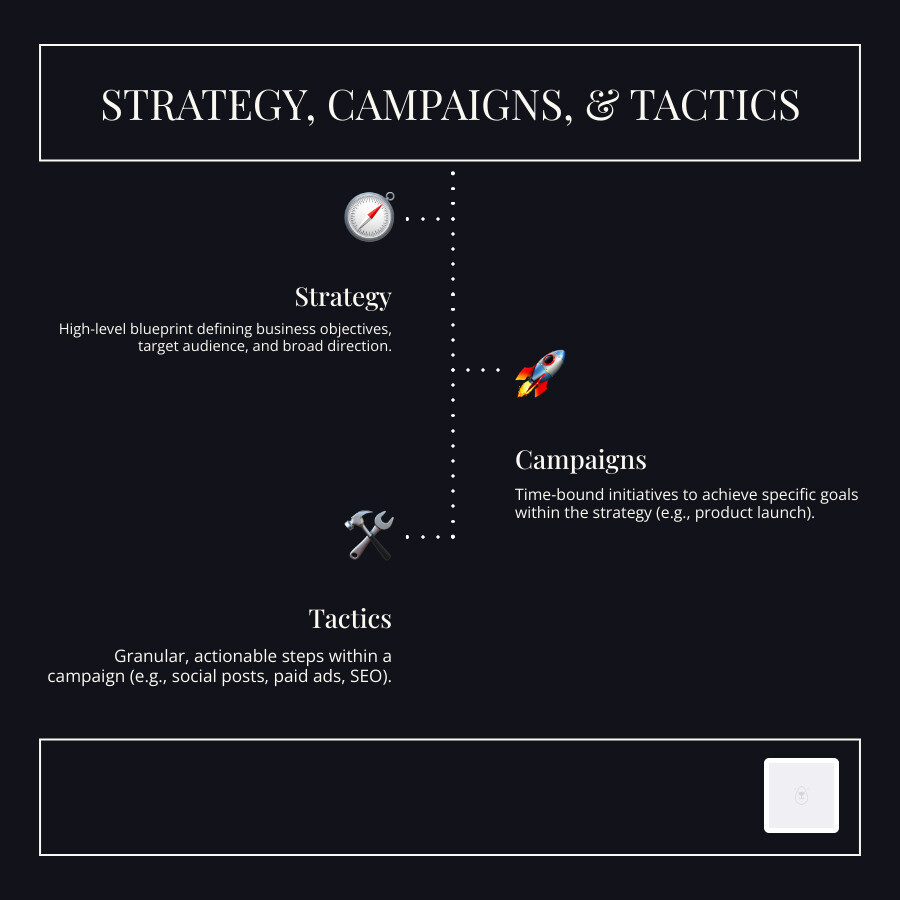
It’s crucial to understand how a digital marketing strategy differs from marketing campaigns and tactics. Think of it this way:
- Strategy: This is your high-level blueprint. It defines your ultimate business objectives, identifies your target audience, and sets the broad direction for all your online activities. For example, a strategy might be to “increase market share by 20% in the next year” or “become the leading thought leader in our niche.”
- Campaigns: Time-bound initiatives designed to achieve specific goals within your overall strategy. A campaign might focus on launching a new product, increasing brand awareness during a particular quarter, or driving sign-ups for an event.
- Tactics: These are the granular, actionable steps you take within a campaign. Examples include creating a specific social media post, running a Google Ads campaign, optimizing a blog post for SEO, or sending an email newsletter.
The relationship is hierarchical: your strategy informs your campaigns, which are executed through various tactics. All three must be aligned with your overall business objectives. A digital marketing strategy is not just about being present online; it’s about being strategically present, ensuring every digital action contributes meaningfully to your business’s growth and success.

Defining Your Digital Marketing Strategy: The Why and What
The first step in crafting any successful digital marketing strategy is to define your business objectives clearly. These aren’t just vague aspirations; they should be Specific, Measurable, Achievable, Relevant, and Time-bound (SMART). Whether you aim to increase revenue by 15%, improve brand engagement by 25%, or reduce customer acquisition costs, setting SMART goals provides a clear target for your digital efforts.
Once your objectives are defined, understanding who you’re trying to reach is paramount. This is where buyer personas and target audience identification come into play. Buyer personas are semi-fictional representations of your ideal customers, based on market research and real data about your existing customers. They include details like demographics, behaviors, motivations, pain points, and goals. By developing comprehensive buyer personas, we can tailor our messaging, content, and channel selection to resonate deeply with our audience. This personalized approach is far more effective than a generic one-size-fits-all message.
Next, we must articulate our value proposition: what unique benefit do we offer that solves our target audience’s problems better than anyone else? This statement should clearly differentiate your business from competitors. A thorough competitive analysis helps us understand the digital landscape, identify opportunities, and refine our unique selling points. By understanding our strengths, weaknesses, and the competitive environment, we can position our digital marketing efforts for maximum impact.
Core Components: From Audience to Analytics
A successful digital marketing strategy is built upon several core components that work in concert to achieve business objectives. These include:
- Owned Media: These are the digital channels your business controls entirely, such as your website, blog, email lists, and social media profiles. We leverage owned media to publish content, build brand authority, and directly engage with our audience.
- Paid Media: This encompasses any marketing efforts where you pay for placement or exposure. Examples include Pay-Per-Click (PPC) advertising on search engines, social media ads, display ads, and sponsored content. Paid media offers immediate reach and precise targeting capabilities.
- Earned Media: This refers to third-party recognition you receive without direct payment. It includes positive reviews, media mentions, social media shares, and word of mouth. Earned media builds credibility and trust, often being perceived as more authentic.
Maximizing the impact of owned, paid, and earned media is a cornerstone of a robust digital strategy.
Content marketing plays a pivotal role across all three media types. It’s the practice of creating and distributing valuable, relevant, and consistent content to attract and retain a clearly defined audience—and ultimately drive profitable customer action. From blog posts and videos to infographics and whitepapers, content marketing fuels SEO, provides value on social media, and converts leads through email campaigns. It establishes your business as a thought leader and nurtures prospects through their journey.
Finally, Key Performance Indicators (KPIs) are essential for tracking digital marketing success. These are measurable values that demonstrate how effectively a company is achieving its business objectives. KPIs can vary widely depending on the specific goals, but common examples include:
- Website Traffic: Unique visitors, page views, bounce rate.
- Lead Generation: Conversion rates, cost per lead (CPL), marketing qualified leads (MQLs).
- Sales/Revenue: Customer acquisition cost (CAC), return on ad spend (ROAS), customer lifetime value (CLTV).
- Engagement: Social media likes, shares, comments, email open rates, and click-through rates.
By defining and consistently monitoring relevant KPIs, we can measure the effectiveness of our strategies, identify areas for improvement, and make data-driven decisions to optimize performance.
Executing Your Digital Marketing Strategy for Growth
Building a digital marketing strategy is one thing; effectively implementing it for growth is another. This stage involves putting the plan into action, leveraging various digital channels, and guiding customers through their journey with your brand. We often conceptualize this journey through models like the Customer Value Journey, which maps out the stages a prospect goes through from initial awareness to becoming a loyal advocate.

The Customer Value Journey typically involves stages such as:
- Awareness: Making potential customers aware of your brand.
- Engagement: Getting them to interact with your content.
- Subscribe: Capturing their contact information.
- Convert: Turning them into a paying customer (even if for a small, introductory offer).
- Excite: Ensuring they have a positive experience with their purchase.
- Ascend: Encouraging repeat purchases and higher-value transactions.
- Advocate: Inspiring them to speak positively about your brand.
- Promote: Motivate them to spread the word actively.
Our task is to strategically engineer our marketing efforts to move people through each of these phases seamlessly. This intentional progression forms the backbone of successful digital marketing implementation.
Integrating Web Design and SEO into Your Digital Marketing Strategy
Your website is often the cornerstone of your digital presence, and its design and search engine optimization (SEO) are inextricably linked. A well-designed website not only provides an excellent user experience (UX) but also lays the foundation for strong SEO performance.
- User Experience (UX): A positive UX ensures visitors can easily steer your site, find the information they need, and complete desired actions. Websites that are intuitive, fast-loading, and visually appealing keep users engaged, which signals to search engines that your site is valuable.
- Mobile-First Indexing: With the majority of internet traffic now coming from mobile devices, Google primarily uses the mobile version of your content for indexing and ranking. Ensuring your website is fully responsive and optimized for mobile is no longer optional; it’s a necessity.
- On-Page SEO: This involves optimizing individual web pages to rank higher and earn more relevant traffic in search engines. Key elements include:
- Keyword Research: Identifying the words and phrases your target audience uses to search for your products or services.
- Content Optimization: Integrating keywords naturally into titles, headings, body text, and meta descriptions.
- Image Optimization: Using descriptive alt text for images.
- Internal Linking: Connecting related pages on your site to improve navigation and distribute link equity.
- Technical SEO: This focuses on the backend aspects of your website to help search engines crawl and index your site more effectively. It includes:
- Site Speed: Optimizing images, leveraging browser caching, and using content delivery networks (CDNs).
- Crawlability and Indexability: Ensuring search engine bots can easily access and understand your content through sitemaps and robots.txt files.
- Structured Data: Implementing schema markup to provide context to search engines about your content.
For businesses looking to make informed decisions about their online presence, a data-driven digital marketing strategy is essential. It ensures that every aspect of your web design and SEO efforts is backed by analytics and user behavior insights, leading to more effective outcomes.
Leveraging Content and Social Media for Lead Generation
Content marketing and social media marketing are powerful levers within a digital strategy, especially for lead generation.
Content creation is at the heart of attracting and nurturing leads. By developing high-quality, valuable content that addresses your audience’s pain points and interests, you can draw them to your website and establish your authority. This content should align with different stages of the customer journey:
- Awareness Stage: Blog posts, infographics, short videos, social media updates that educate and entertain.
- Consideration Stage: Whitepapers, e-books, webinars, and case studies that offer deeper insights and solutions.
- Decision Stage: Product comparisons, demos, free trials, and consultations that help prospects make a choice.
Social media marketing involves utilizing platforms like Facebook, Instagram, LinkedIn, and X to build brand awareness, engage with your audience, drive traffic, and generate leads. Nearly 7 in 10 shoppers report using social media for either shopping inspiration or to make purchases directly, underscoring its influence. Effective social media strategies involve:
- Audience Targeting: Reaching specific demographics and interest groups with custom content.
- Community Building: Fostering engagement and interaction with your followers.
- Paid Social Advertising: Running targeted ad campaigns to expand reach and drive conversions.
- Influencer Marketing: Collaborating with relevant influencers to promote your products or services.
Email marketing remains one of the most effective digital marketing channels for nurturing leads and building customer relationships. From initial sign-ups to loyal advocates, email allows for personalized, behavior-driven communication. It’s an excellent channel for delivering lead magnets, promoting new content, and announcing special offers.
Lead magnets are valuable resources offered to prospects in exchange for their contact information (typically an email address). They are crucial for moving prospects from the engagement to the subscribe stage of the customer journey. For businesses seeking to optimize lead generation, implementing a proprietary digital marketing strategy that integrates unique lead-magnet approaches can significantly boost conversion rates.
Here are some effective lead magnet ideas:
- E-books or Whitepapers: In-depth guides on a topic relevant to your audience.
- Checklists or Templates: Practical tools that simplify a process for your users.
- Webinars or Online Courses: Educational content delivered live or on demand.
- Free Trials or Demos: Hands-on experience with your product or service.
- Quizzes or Assessments: Interactive tools that provide personalized insights.
- Exclusive Content: Access to a private community, newsletter, or video series.
By strategically combining compelling content, engaging social media presence, and effective lead magnets, businesses can consistently attract and convert prospects into valuable leads.
Measuring, Adapting, and Overcoming Challenges
The digital landscape is constantly shifting, which means a digital marketing strategy cannot be static. Continuous improvement, future-proofing, and adaptability are not just buzzwords; they are essential for sustained success. The past year alone saw 20% of marketers pivot their established plans due to economic uncertainties, highlighting the need for agility.
Measuring Success and Adapting Your Approach
Measuring the effectiveness of your digital marketing strategy is paramount. Without robust measurement, it’s impossible to know what’s working, what isn’t, and where to allocate resources.
- Performance Measurement: This involves tracking the KPIs we defined earlier. Regularly reviewing metrics such as website traffic, conversion rates, lead quality, and customer engagement provides insights into the health of your digital efforts.
- Analytics Tools: Platforms such as Google Analytics, social media insights, and email marketing dashboards provide the data needed to monitor performance. These tools allow us to understand user behavior, identify trends, and pinpoint areas for optimization.
- A/B Testing: This involves comparing two versions of a web page, email, ad, or other marketing asset to see which one performs better. A/B testing is a scientific approach to optimizing elements such as headlines, calls to action, images, and layouts.
- Conversion Rate Optimization (CRO): CRO is the systematic process of increasing the percentage of website visitors who complete a desired goal, such as filling out a form, making a purchase, or clicking a button. It involves understanding how users behave on your site, what prevents them from converting, and then implementing changes to improve the user experience and guide them towards conversion.
- Iterative Planning: Digital marketing is not a one-and-done process. It requires continuous monitoring, analysis, and adjustment. An iterative approach means we constantly refine our strategies and tactics based on performance data, market changes, and emerging trends. This ensures our efforts remain relevant and effective.
To truly excel in this environment, businesses need an approach that allows for flexibility and growth. A scalable digital marketing strategy focuses on building systems and processes that can expand or contract with business needs, ensuring that marketing efforts can keep pace with organizational development and market demands.
The Future of Digital Strategy: AI and Common Problems
The advent of Artificial Intelligence (AI) has significantly impacted the creation and execution of digital marketing strategies. AI tools, particularly Generative AI (GenAI) like ChatGPT and Google Gemini, are no longer just for copywriting; they are increasingly used to:
- Improve Strategy Development: AI can analyze vast datasets to identify market trends, predict consumer behavior, and uncover untapped opportunities, helping marketers refine their strategic direction.
- Automate Tasks: From scheduling social media posts and optimizing ad bids to personalizing email campaigns and generating basic content outlines, AI automates repetitive tasks, freeing up human marketers for more strategic work.
- Improve Personalization: AI-driven algorithms can deliver highly personalized content and product recommendations, enhancing user experience and conversion rates.
- Optimize Performance: AI can continuously monitor campaign performance, identify inefficiencies, and suggest real-time adjustments to maximize ROI.
Despite these advancements, developing and implementing digital marketing strategies comes with common challenges:
- Rapidly Evolving Landscape: The constant emergence of new platforms, technologies, and consumer behaviors makes it challenging to stay current and adapt strategies.
- Data Overload and Analysis Paralysis: While data is abundant, effectively collecting, analyzing, and deriving actionable insights from it can be overwhelming for many organizations.
- Budget Constraints: Allocating sufficient resources to various digital channels and tools, especially for smaller businesses, can be a significant hurdle.
- Talent Gap: Finding and retaining skilled digital marketing professionals who can steer complex tools and strategies is a persistent challenge.
- Attribution Complexity: Accurately attributing conversions and revenue to specific digital touchpoints across a multi-channel journey can be difficult.
Finally, a digital marketing strategy must be adapted to different business types.
- B2B vs. B2C: B2B strategies often focus on longer sales cycles, lead nurturing, thought leadership, and platforms like LinkedIn. B2C strategies typically emphasize brand awareness, emotional connection, impulse purchases, and platforms like Instagram, TikTok, and Facebook.
- Startups vs. Large Enterprises: Startups often prioritize cost-effective tactics like organic social media, content marketing, and SEO to build initial traction with limited budgets. Large enterprises have the resources for broader, more integrated campaigns, leveraging advanced analytics, extensive paid media, and sophisticated marketing automation.
Regardless of the business type, the core principles remain: define your goals, understand your audience, choose the right channels, create compelling content, and continuously measure and adapt. By embracing these principles and staying agile in the face of change, any organization can build a strong, impactful online presence.

