Tech
Boost Rankings with a Custom SEO Tech Audit: Fix Errors & Optimize Speed

The Foundational Pillars: Crawling, Indexing, and Architecture
Why a Generic Checklist Isn’t Enough: The Case for a Custom SEO Tech Audit
While generic SEO checklists can offer a starting point, they often fall short of providing the depth needed for true competitive advantage. A one-size-fits-all approach overlooks the unique aspects of each business and its digital presence. Every website has distinct business goals and a specific level of complexity, operates within a particular industry, and faces a unique competitive landscape. For instance, an e-commerce giant will have vastly different technical needs than a local service provider or a content-heavy news site.
A custom SEO tech audit moves beyond simply ticking boxes. It involves a deep analysis custom to your situation, identifying issues that generic tools might miss. This proactive approach helps you anticipate problems rather than reacting to them after they’ve impacted your rankings and traffic. It ensures that every technical optimization aligns with your overarching business objectives, turning your website into a powerful, efficient sales and marketing machine.
The journey of any webpage to a search engine’s results page begins with crawling and indexing. If search engine bots, like Googlebot, cannot efficiently access and understand your content, it simply won’t appear in search results. This is where the foundational pillars of technical SEO come into play: ensuring optimal crawlability, indexation status, and a robust site architecture.
Crawl budget refers to the number of pages Googlebot will crawl on your site within a given timeframe. If your site has technical issues, Googlebot might waste its budget on unimportant pages or get stuck, leaving valuable content unfindable. Poor indexation means that even if a page is crawled, it might not be added to Google’s vast database, making it impossible for users to find.
A well-planned site architecture and internal linking structure are crucial for guiding search engines and users through your website. They help establish topical authority and distribute “link equity” across your pages, signaling their importance.
Assessing Crawlability and Indexability
To ensure your website is findable, we carefully examine several key elements:
- Robots.txt file: This file tells search engine crawlers which parts of your site they can or cannot access. A misconfigured
robots.txtcan inadvertently block critical pages from being crawled, effectively hiding them from search engines. We use tools like Google’s robots.txt tester to ensure it’s correctly configured and does not cause any unintended blocks. - XML sitemaps: An XML sitemap acts as a roadmap for search engines, listing all the important pages on your site that you want them to crawl and index. It’s especially useful for large sites or those with complex structures. We confirm that your XML sitemap is up-to-date, includes only indexable pages, and is properly submitted to search engines. The importance of a comprehensive and structured sitemap cannot be underestimated.
- Meta robots tags: These HTML snippets provide instructions to search engines at the page level. A
noindextag, for example, tells search engines not to include a page in their index. We check for incorrectnoindexornofollowtags on pages that should be visible, preventing accidental exclusion. - HTTP status codes: When a user or a search engine requests a page, the server responds with an HTTP status code. We look for 200 (OK) for live pages, 301 (permanent redirect) for moved pages, and identify 404 (not found) or 5xx (server error) codes that indicate broken pages or server issues. These errors can waste crawl budget and frustrate users.
- Google Search Console coverage report: This invaluable tool provides insights directly from Google about how your pages are being crawled and indexed. We analyze the coverage report to identify errors, valid pages, and excluded pages, helping us pinpoint specific indexation problems.
- URL Inspection Tool: For a deeper dive into individual pages, Google’s URL Inspection Tool allows us to see how Google views a specific URL, including crawl status, indexation, and any potential issues.
By thoroughly assessing these components, we ensure that search engines have optimal access to your valuable content, laying the groundwork for improved visibility.
Auditing Site Structure and Internal Linking
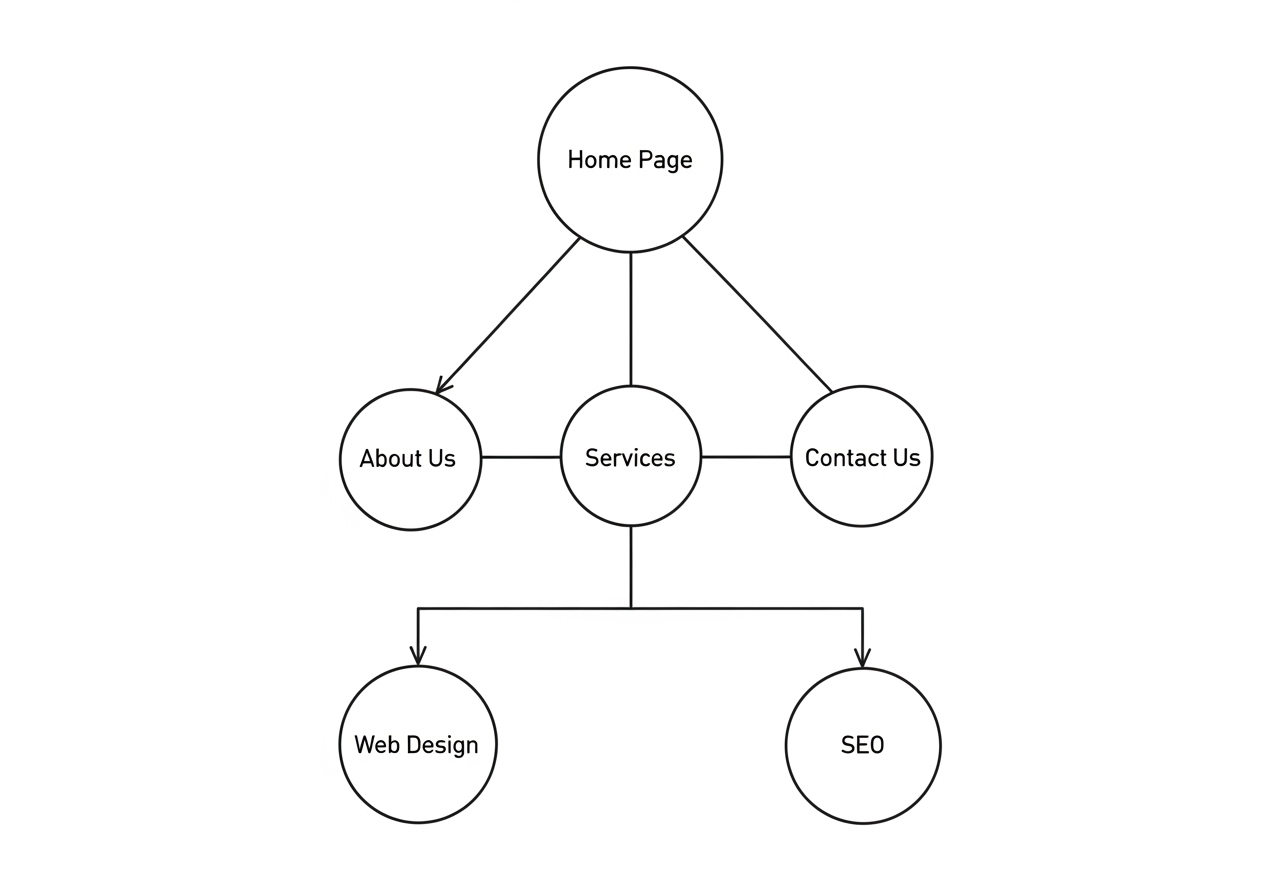
A well-organized website is not just good for users; it’s essential for SEO. Your site architecture dictates how easily search engines can steer and understand the relationships between your pages. We audit your site’s structure to ensure:
- Logical hierarchy: Content should be organized clearly and intuitively, typically with important pages accessible within a few clicks from the homepage. A basic website layout should make sense, with related content grouped together.
- Click depth: This refers to how many clicks it takes to reach a page from the homepage. Important content should have a low click depth (ideally 3 clicks or less) to ensure users and crawlers easily find it.
- Orphaned pages: These are pages with no internal links pointing to them, making them difficult for search engines to find. Tools like Screaming Frog or Sitebulb can help identify these hidden pages.
- Breadcrumbs: These navigational aids help users understand their location within your site’s hierarchy and provide additional internal links for crawlers. Implementing breadcrumbs is a strong SEO strategy.
- URL structure: URLs should be clean, descriptive, and keyword-rich, reflecting the page’s content. Google provides good documentation on creating friendly URL structures.
- Canonicalization: For pages with identical or very similar content (e.g., product pages with different color variations), a canonical tag tells search engines which version is the “master” copy, preventing duplicate content issues.

Conducting a Custom SEO Tech Audit for Peak Performance
Beyond crawlability and indexability, a critical aspect of technical SEO is optimizing for page experience. Google has increasingly emphasized user experience (UX) as a ranking factor, especially with the rollout of mobile-first indexing. This means your website must not only be technically sound but also provide a seamless, fast, and intuitive experience for users, particularly on mobile devices.
Auditing Page Speed and Core Web Vitals
Page speed is paramount. For every additional second of load time, conversion rates drop. Google confirmed that site loading speed is a ranking factor back in 2010, and its importance has only grown, especially for mobile. In 2021, Core Web Vitals became an official ranking factor, measuring three key aspects of user experience:
- Largest Contentful Paint (LCP): Measures loading performance. Ideally, your LCP should be 2.5 seconds or better.
- Cumulative Layout Shift (CLS): Measures visual stability. A low CLS score (0.1 or less) means elements on your page aren’t shifting unexpectedly as it loads, preventing frustrating user interactions.
- Interaction to Next Paint (INP): Measures responsiveness, specifically how quickly your website responds to user interactions. This became a Core Web Vital in 2024.
To audit these metrics, we rely on powerful tools like Google PageSpeed Insights. This tool provides scores for both mobile and desktop and offers actionable recommendations for improvement. Other tools like GTmetrix and Pingdom also provide valuable insights into total load time.
Common optimizations to improve page speed include:
- Image compression: Large images are often culprits for slow load times. Tools like Kraken or Squoosh can significantly reduce file sizes without compromising quality.
- Code minification: Reducing the size of your CSS, JavaScript, and HTML files by removing unnecessary characters and whitespace can speed up loading. We recommend using Gzip for file compression.
- Leveraging browser caching: Browsers can store certain website resources (like images and stylesheets) so they don’t have to be reloaded whenever a user visits your site. Proper Cache-Control settings can dramatically improve repeat visitor experience.
- Content Delivery Networks (CDNs): CDNs store copies of your website’s content on servers worldwide, delivering it from the closest server to the user, thus reducing latency.
Ensuring a Flawless Mobile Experience
With 52% of global internet traffic now coming from mobile devices, and Google’s complete rollout of mobile-first indexing in 2023, a mobile-friendly website is non-negotiable. Google now primarily uses the mobile version of your site for indexing and ranking across all devices.
We audit your mobile experience by:
- Mobile-friendliness test: Google’s Mobile-Friendly Test is a quick way to check if a page is responsive and easy to use. It shows how Google renders the page on mobile and flags any issues.
- Responsive design: We verify that your website adapts seamlessly to different screen sizes and orientations. This includes checking for proper viewport configuration, adequate tap target sizes, and readable font sizes on small screens.
- Content and links consistency: A common technical SEO mistake is having different content or internal links on mobile versus desktop versions. Googlebot now crawls with mobile Googlebot, so inconsistencies can lead to indexing issues.

Advanced Technical Checks for Deeper Insights
Once the foundational elements and core performance metrics are optimized, we dig into more advanced technical aspects that can significantly impact your search visibility and user experience. These include tackling duplicate content, leveraging structured data, ensuring robust website security, and understanding internationalization.
Identifying and Resolving Duplicate Content
Duplicate content occurs when identical or near-identical content appears on multiple URLs. While Google typically won’t penalize you for it, it can confuse search engines, making it difficult for them to determine which version to rank, potentially diluting your ranking signals. Statistics show that 29% of pages have duplicate content problems.
We identify and resolve duplicate content issues by looking at:
- Content duplication causes: This can stem from various sources, such as URL variations (e.g.,
http://example.comvs.https://example.com,www.example.comvs.example.com, trailing slashes, or URL parameters). We ensure only one version of your site is browsable. - Canonical tags: These HTML elements tell search engines the preferred version of a page when multiple versions exist. Implementing a canonical tag is crucial for consolidating ranking signals.
- 301 redirects: For permanently moved or consolidated pages, a 301 redirect signals to search engines that the content has moved, passing on link equity to the new URL.
- Parameter handling: URL parameters (e.g.,
?sessionid=,?sort=) can create numerous duplicate URLs. Google Search Console’s Parameter tool can help manage these. - Scraped content issues: Sometimes, other websites copy your content. While Google aims to show pages with distinct information, if scraped content outranks yours, you might consider filing a DMCA complaint or asking for attribution.
Auditing Structured Data and Security
These elements might seem behind the scenes, but they significantly influence how your site appears in search results and how users perceive its trustworthiness.
- Structured data markup: This is a standardized format for providing information about a webpage and classifying its content. It helps search engines better understand your content and can enable rich SERPs results (e.g., star ratings, product prices, FAQ accordions), boosting click-through rates. Unfortunately, 80% of websites haven’t implemented schema markup. We audit your structured data using tools like Google’s Structured Data Testing Tool or Schema Validator to ensure it’s correctly implemented and eligible for rich results. The role of structured data in technical SEO is growing in importance.
- HTTPS implementation: Security is a ranking signal. We verify that your site uses HTTPS (Hypertext Transfer Protocol Secure), ensuring encrypted communication between your server and users’ browsers. This builds trust and is considered standard practice. Check out The Impact of HTTPS on SEO for more details.
- HSTS (HTTP Strict Transport Security): While not a direct ranking factor, Google recommends using HSTS to increase security by instructing browsers to always load your site over HTTPS.
- Mixed content errors occur when an HTTPS page loads insecure HTTP resources (images, scripts, stylesheets). They can trigger browser warnings and negatively impact user trust.
- Backlink profile health: While primarily an off-page SEO factor, a technical audit often includes a quick check for toxic links. We review your backlink profile to identify any potentially harmful or spammy links that could trigger a manual penalty or algorithmic demotion. If necessary, we advise on using Google’s Disavow Tool, though this should be done with extreme caution.


From Audit to Action: Prioritizing and Implementing Fixes
A comprehensive technical SEO audit generates a wealth of data, highlighting numerous issues. The real value, however, lies in translating these audit findings into actionable steps that drive tangible results. Without a clear prioritization strategy and a plan for implementation, even the most detailed audit can gather dust.
Our approach focuses on building a robust action plan from your custom SEO tech audit, ensuring that resources are allocated effectively and fixes are implemented efficiently.
Building Your Action Plan from a Custom SEO Tech Audit
- Prioritization Matrix: Not all issues are created equal. We categorize findings based on their potential impact on organic traffic and rankings versus the effort required to fix them. High-impact, low-effort fixes are tackled first, offering quick wins and demonstrating immediate value.
- High Impact / Low Effort: Quick wins that can significantly improve performance (e.g., fixing critical
robots.txtblocks, broken internal links on high-traffic pages). - High Impact / High Effort: Strategic projects that require significant development resources but promise substantial long-term gains (e.g., a complete site architecture overhaul, major Core Web Vitals improvements).
- Low Impact / Low Effort: Minor optimizations that can be batched and addressed when time permits.
- Low Impact / High Effort: Issues are typically deprioritized or addressed only after handling all other categories.
- Creating a Roadmap: We develop a clear roadmap outlining each recommended fix, its priority level, the responsible team member (e.g., developer, content writer, marketing specialist), and a realistic timeline. This ensures accountability and smooth workflow.
- Assigning Tasks and Developer Collaboration: Effective communication between SEOs and developers is crucial. We translate technical SEO recommendations into clear, concise tasks that developers can understand and implement. This might involve creating detailed tickets with specific URLs, error descriptions, and proposed solutions. Streamlining this process can save dozens of hours per month.
- Measuring Results: Post-implementation, we continuously monitor the impact of the fixes using tools like Google Search Console and Google Analytics. Tracking changes in crawl stats, indexation rates, Core Web Vitals scores, and organic traffic allows us to quantify the improvements and refine our strategy. Websites doing routine audits saw up to a 61% increase in organic traffic.
This systematic approach ensures that your carefully brewed custom SEO audit doesn’t just identify problems, but actively contributes to your website’s growth and success.
Frequently Asked Questions about Technical SEO Audits
How often should you perform a technical SEO audit?
The frequency of technical SEO audits depends on several factors, including your website’s size, complexity, and the rate at which you make changes.
- Initial Comprehensive Audit: This is a deep dive, typically performed when you first take over a website, start on a major redesign, or notice significant drops in performance.
- Regular Health Checks: For most websites, a full, comprehensive audit should be conducted at least annually. However, many SEO specialists recommend a quarterly deep dive to stay ahead of potential issues and algorithm changes.
- After Major Site Changes: Any significant changes, such as platform migrations, major content updates, or new feature rollouts, warrant a mini-audit to ensure no new technical issues have been introduced.
- Monitoring Tools: Continuous monitoring tools can help you track your site’s technical health daily, alerting you to critical issues as they arise and allowing for proactive fixes.
What is the difference between a technical, on-page, and off-page SEO audit?
These three types of audits represent the fundamental pillars of a holistic SEO strategy, each focusing on different aspects of your website’s optimization:
- Technical SEO Audit: This focuses on the website’s infrastructure and backend elements to ensure search engines can efficiently crawl, index, and render your site. It deals with server-side issues, site architecture, crawlability, indexability, site speed, mobile-friendliness, security (HTTPS), structured data, and more. It’s the foundation upon which all other SEO efforts are built.
- On-Page SEO Audit: This examines the content and HTML source code of individual pages to optimize them for target keywords and user experience. It includes analyzing title tags, meta descriptions, headings (H1-H6), content quality and relevance, keyword usage, internal linking, image optimization (alt text), and user engagement signals.
- Off-Page SEO Audit: This looks at external factors influencing your website’s authority and reputation. The primary focus is on your backlink profile (the quality and quantity of links pointing to your site), but it also considers brand mentions, social signals, and local SEO citations.
While distinct, these audits are highly interrelated. A strong technical foundation (technical SEO) allows your well-optimized content (on-page SEO) to be found, and a healthy backlink profile (off-page SEO) boosts its authority.
What are the challenges of auditing large-scale websites?
Auditing large-scale websites (e.g., those with over 1 million URLs) presents unique challenges that require specialized strategies and tools:
- Crawl Volume: Standard desktop crawlers like Screaming Frog can struggle with millions of URLs, often running out of memory or taking days to complete.
- Data Analysis: The sheer volume of data generated can be overwhelming to analyze manually, making it difficult to pinpoint critical issues.
- Prioritization Complexity: With thousands of potential issues, prioritizing fixes becomes a complex task, requiring sophisticated filtering and impact assessment.
- Enterprise-Level Tools: Specialized SaaS platforms designed for enterprise SEO are often necessary to handle the scale. These tools offer advanced crawling capabilities, robust reporting, and integration with other systems.
- Sampling Techniques: Instead of attempting to crawl every URL, strategists often employ sampling techniques, crawling representative sections or page types to extrapolate findings across the entire site. Breaking down large crawls into subdirectories is also a common tactic.
- Development Resources: Implementing fixes on large sites often requires significant developer time, making clear communication and efficient task management paramount.
Conclusion
A technical SEO audit is far more than a routine check-up; it’s a strategic imperative for any business serious about its online presence. We’ve explored the critical areas, from ensuring search engines can crawl and index your site efficiently to optimizing for lightning-fast page speeds and flawless mobile experiences. We’ve also dug into advanced checks like duplicate content resolution, structured data implementation, and maintaining robust website security.
The long-term benefits of regular, carefully brewed custom SEO audits are undeniable: increased organic traffic, higher search engine rankings, improved user satisfaction, and ultimately, sustainable business growth. By proactively addressing technical issues, you safeguard your investment in content and marketing, ensuring your website performs as a powerful asset rather than a hidden liability.
Don’t let technical glitches hold your website back. Prioritize your technical health today and open up your full online potential.
Ready to take control of your technical SEO?
Consider a carefully brewed custom SEO audit for a comprehensive review of your website’s technical health and a roadmap to improved performance.

