
Tech
Digital Printing Trends for Modern Business Applications


Key Takeaways
- Personalization through Variable Data Printing enhances customer engagement.
- Eco-friendly practices in digital printing align with consumer preferences for sustainability.
- Integration of Augmented Reality in print materials offers interactive experiences.
- On-Demand Printing reduces waste and meets immediate market needs.
- Advancements in 3D Printing open new avenues for product development.
In today’s highly competitive business environment, organizations are constantly seeking innovative ways to stand out and adapt to ever-evolving market demands. Among the most transformative tools available is digital printing, which has revolutionized how businesses approach marketing, communication, and product development. The ability to deliver highly tailored, professional-quality materials with exceptional speed and flexibility gives companies an undeniable edge. Whether it’s creating vibrant marketing collateral, dynamic packaging, or unique promotional products, digital printing’s agility allows businesses to respond promptly to shifting customer expectations without sacrificing quality. Organizations must stay informed about the latest trends to maximize these benefits and continually assess how digital printing can streamline operations and support sustainable growth.
Modern consumers are now demanding more personalized, interactive, and eco-friendly experiences from the brands they engage with. Businesses that embrace these evolving requirements are not only fostering loyalty but are also remaining at the forefront of innovation. The digital printing landscape now supports sustainability through environmentally conscious materials and methods, while also facilitating creative engagement through technologies like Augmented Reality (AR) and variable data printing. Resources such as the digital large format printing guide provide valuable strategies and practical insights that empower companies to optimize their print operations for efficiency and impact.
Understanding and leveraging these digital printing advancements can significantly enhance a company’s ability to engage, retain, and excite modern audiences. By integrating digital printing into their broader marketing strategies, companies can unlock new levels of brand differentiation and customer connection. This technology also supports faster prototyping and shorter production cycles, enabling quicker go-to-market timelines for new products. As digital capabilities continue to evolve, businesses investing in innovative printing solutions will be better positioned to lead in creativity and operational excellence.
Personalization Through Variable Data Printing
The increasing desire for unique, individualized experiences is shaping the way brands communicate and market to their audiences. With Variable Data Printing (VDP), businesses can go beyond static messaging and deliver truly customized content that resonates with each recipient on a personal level. VDP transforms ordinary print pieces like postcards, catalogs, and direct mailers into compelling, one-of-a-kind marketing tools by dynamically changing elements such as names, images, offers, or even languages. This degree of customization enhances the customer journey, making every communication feel relevant and thoughtfully crafted. A fitness center might distribute personalized flyers with class schedules and offers based on a member’s fitness history. At the same time, a retailer could send individualized discount codes based on each customer’s shopping habits. Such targeted engagement leads to demonstrable increases in response rates, brand loyalty, and overall campaign ROI.
Benefits of Variable Data Printing
- Higher customer retention and response rates, as communications are tailored to specific interests and needs.
- Seamless A/B testing to fine-tune messaging strategies for different audience segments, maximizing effectiveness.
- Cost-effective campaigns that minimize waste by printing only relevant, targeted materials.
Embracing Eco-Friendly Printing Practices
As society becomes more conscious of environmental impact, businesses are being held to higher sustainability standards. The digital printing industry is embracing this change by incorporating a range of environmentally friendly materials and workflows. Modern printing solutions include the use of recycled papers, water-based or soy-based inks, and print processes that reduce energy consumption. Many print providers are also committing to rigorous sustainability certifications, like those from the Forest Stewardship Council (FSC), to assure customers of their dedication to responsible practices. Closed-loop recycling systems and reduced chemical usage further demonstrate a proactive approach to minimizing environmental footprints.
Adopting these green practices enhances brand reputation, fosters loyalty among eco-aware consumers, and often leads to long-term cost savings by reducing material waste and utility expenses. Companies that communicate their commitment to sustainability through transparent reporting and eco-labeling strengthen both their credibility and their relationships with key stakeholders. Notably, sustainable printing doesn’t mean compromising on quality—modern advancements ensure that environmentally friendly materials deliver results that meet, and often exceed, traditional standards.
Why Sustainability Matters in Printing
- Meets growing consumer demand for ethical and eco-friendly products and services.
- Supports a company’s corporate social responsibility (CSR) initiatives and enhances public perception.
- Reduces operational costs over time through resource conservation and waste minimization.
Integrating Augmented Reality in Print Materials
The convergence of digital and physical experiences is redefining how brands interact with customers—and Augmented Reality (AR) is at the forefront of this new wave. By integrating AR markers, QR codes, or other digital triggers into printed materials, businesses can offer interactive and immersive experiences that were previously unimaginable. With a quick scan from a smartphone, printed catalogs, flyers, or business cards can instantly come to life, displaying 3D product models, how-to videos, customer reviews, or even direct purchase options. This not only increases time spent engaging with the material but also drives meaningful conversions by making information more accessible and engaging.
Real-world applications of AR are diverse and expanding across industries. Real estate agencies, for instance, can provide virtual property walkthroughs via printed brochures. Retail packaging can connect consumers to nutritional information, assembly instructions, or brand storytelling through interactive AR overlays. By bridging the offline and online worlds, AR not only boosts return on investment but also creates memorable, shareable experiences that differentiate brands in crowded markets.
Leveraging On-Demand Printing
The traditional mass-production approach to printing often leads to unnecessary costs, wasted inventory, and slow turnaround times. On-demand digital printing upends this model by enabling businesses to only print materials as they’re needed, in quantities that match current demand. This just-in-time system eliminates the risks of surplus or obsolete inventory while providing unparalleled responsiveness to changing market conditions. On-demand printing allows for timely updates and rapid deployment for businesses running frequent promotions, responding to seasonal trends, or localizing campaigns for diverse markets.
Furthermore, on-demand printing reduces reliance on warehousing and distribution, resulting in lower overhead and improved cash flow. Smaller print runs are now economically viable, empowering small businesses and startups to compete with larger firms without incurring significant up-front costs. The agility on-demand printing offers is particularly valuable in industries characterized by rapid change, such as fashion, food and beverage, technology, and event planning.
Advantages of On-Demand Printing for Modern Businesses
- Eliminates the risk and costs associated with maintaining large stocks of outdated materials.
- Streamlines supply chains by reducing storage and distribution burdens.
- Enables rapid adaptation to emerging trends and immediate market feedback, fostering innovation.
Exploring 3D Printing in Business Applications
3D printing, also known as additive manufacturing, is dramatically expanding what businesses can achieve across a range of industries. Unlike traditional subtractive manufacturing, which carves parts from larger materials, 3D printing builds objects layer by layer, opening up new possibilities for creativity, efficiency, and customization. Companies are leveraging this technology for rapid prototyping, where design changes can be made and tested in a matter of hours, as well as for the low-volume manufacturing of complex, geometrically challenging products.
In the healthcare sector, bespoke surgical models, implants, and prosthetics can now be tailored precisely to an individual’s requirements, significantly improving patient outcomes and satisfaction. Automotive businesses are deploying 3D printing for both prototyping and final parts production—benefiting from cost savings, agility in design, and reduced material waste. Architects and designers are also taking advantage of 3D printing to create intricate display models, helping clients better visualize projects and streamlining the approval process. The possibilities continue to grow as material science and printer capabilities evolve, turning 3D printing into an indispensable tool for accelerating innovation cycles and customized manufacturing.
Key Opportunities in 3D Printing
- Speeds up time-to-market by enabling fast design iterations and prototyping.
- Empowers businesses to offer highly customized products tailored to individual needs.
- Makes it viable to manufacture small batches of complex products cost-effectively.
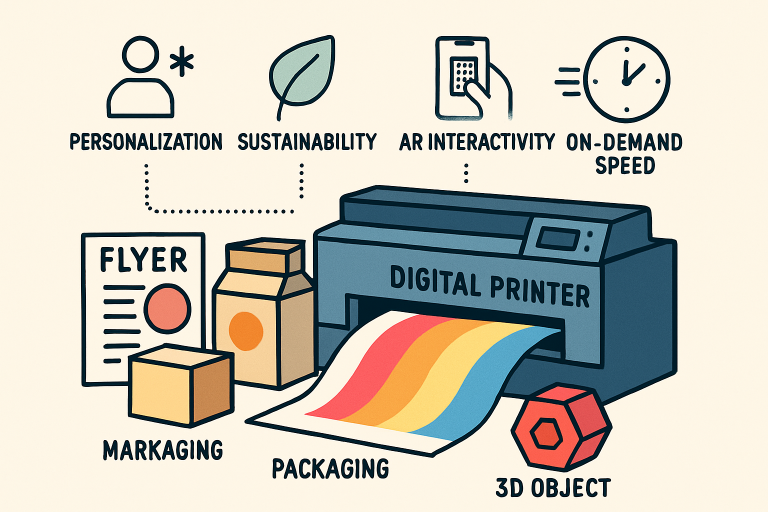
Keeping up with major digital printing trends is essential for organizations striving to remain relevant and competitive in a fast-changing marketplace. By harnessing advanced solutions—personalization, sustainability, interactivity, on-demand fulfillment, and next-generation 3D printing—businesses are better equipped to meet evolving customer expectations and unlock opportunities for sustainable growth.
Conclusion
Digital printing continues to redefine how businesses communicate, innovate, and grow in today’s dynamic market. From the powerful personalization of Variable Data Printing to the interactive potential of Augmented Reality, the digital print landscape offers tools that enhance customer engagement and operational efficiency. Embracing eco-friendly practices and leveraging on-demand and 3D printing technologies aligns with modern values and delivers tangible benefits in cost, speed, and customization. As consumer expectations shift toward more meaningful, sustainable, and immersive experiences, companies that stay ahead of these trends will gain a decisive competitive advantage. By strategically integrating these digital printing advancements into their workflows, organizations can create lasting impressions, reduce waste, and accelerate their path to innovation. Ultimately, the businesses that lead with agility and intention in the print space will be the ones that thrive in the future.