
Tech
How Tough Is SS 316? A Deep Dive into Its Strength and Durability


Key Takeaways
- SS 316 offers a unique balance of strength, ductility, and corrosion resistance due to its alloy composition.
- The material stands out in high-stress, corrosive, and temperature-extreme environments.
- It is widely used in marine, chemical, medical, and food industry applications.
- Regular maintenance is key to maximizing its lifespan and reliability.
Composition and Its Impact on Strength
SS 316, formally known as Stainless Steel 316, is an austenitic alloy with a reputation for toughness and resilience in some of the world’s harshest environments. Its composition sets it apart from other stainless steels and is dominated by iron, complemented by 16-18% chromium, 10-14% nickel, and 2-3% molybdenum. This unique blend of elements defines the alloy’s crystalline structure and elevates its strength, toughness, and resistance to a plethora of corrosive agents, which is critical in many industrial sectors. The synergy of chromium, nickel, and molybdenum makes the difference between ordinary steel and a material that consistently withstands demanding applications. For more detailed and precise information on these alloying elements and their effects, reviewing SS 316 material properties can help clarify how these percentages translate to real-world durability and resilience.
The addition of molybdenum, although a small percentage by weight, has an outsized effect on resisting localized attacks such as pitting and crevice corrosion—types often encountered in marine and chemical handling environments. Chromium, on the other hand, forms a passive oxide layer on the steel’s surface, drastically improving its ability to ward off rust and corrosion from various chemicals. Nickel plays a critical stabilizing role, promoting the austenitic structure that imparts SS 316 with both hardness and ductility. This well-considered alloy composition means SS 316 can be fabricated into highly durable components with high mechanical and environmental demands.
Mechanical Properties: Tensile and Yield Strength
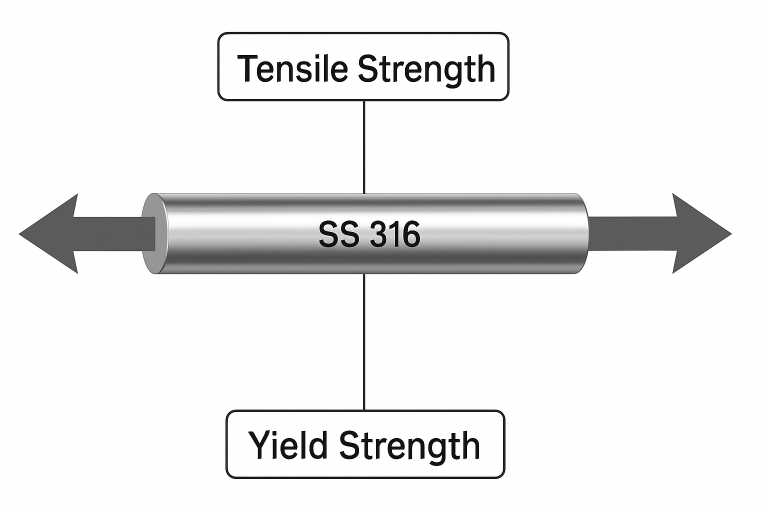
When evaluating the structural aptitude of SS 316, tensile and yield strength are two pivotal properties that engineers and designers closely examine. Tensile strength, which measures the maximum stress the material can endure while being pulled or stretched before fracturing, is a key indicator of how a component will behave under heavy loads. SS 316’s tensile strength is approximately 515 MPa (75,000 psi), positioning it as a strong performer among austenitic stainless steels. Yield strength, on the other hand, signals the point at which the material begins to deform permanently under stress, and for SS 316, this value is around 205 MPa (30,000 psi).
- Tensile Strength: Approximately 515 MPa (75,000 psi)
- Yield Strength: Roughly 205 MPa (30,000 psi)
These mechanical attributes reflect SS 316’s remarkable ability to endure significant pressure, flex without failing, and return to its original form when the force is removed within its elastic limits. The alloy’s robust performance is a go-to choice for safety-critical applications such as pressure vessels, structural supports in chemical plants, and architectural components in coastal environments. The interplay between tensile and yield strength also ensures that SS 316 can withstand dynamic forces and vibrations over years of use without suffering from fatigue failures.
Ductility and Hardness
Absolute strength alone is rarely considered in engineering applications—ductility, or the material’s ability to deform without breaking, is equally critical. SS 316 distinguishes itself with a high elongation at break of about 40%. This indicates that SS 316 can be stretched nearly halfway again as long as its original length before it finally snaps. This property is invaluable in environments where sudden shocks, heavy impacts, or unexpected loading might be encountered, as the material will bend rather than crack, thereby absorbing kinetic energy safely.
On the Rockwell hardness scale, SS 316 typically measures around 79 on the B scale, confirming its intermediate position between malleability and toughness. For engineers and fabricators, this means that parts made from SS 316 can be worked reliably without excessive brittleness or risk of cracking, while retaining the rigidity required to maintain shape under pressure. This sweet spot makes SS 316 an ideal candidate for components such as springs, fasteners, and fittings that require strength and the capacity to accommodate small deformations over time.
Performance in Extreme Temperatures
One of SS 316’s most impressive features is its reliable performance across a broad spectrum of temperatures. In high-heat settings, SS 316 retains both its strength and ductility, remaining structurally resilient at temperatures up to 800°C (about 1,472°F). This thermal stability is crucial in industrial ovens, power generation plants, and exhaust systems, where frequent and extreme temperature fluctuations are typical.
Conversely, SS 316’s austenitic structure maintains its toughness even at cryogenic temperatures. It is suitable for use in scientific research facilities, space exploration equipment, and the storage or transportation of liquefied gases. The alloy’s resistance to thermal shock makes it reliable at high and low temperatures and durable enough for repeated transitions without losing its structural integrity or developing fractures.
Comparing SS 316 to Other Stainless Steels
SS 316 is frequently compared to other popular stainless steels, especially SS 304, which is widely used across industry. While SS 304 boasts excellent general corrosion resistance, SS 316’s higher molybdenum content directly translates to superior pitting and crevice corrosion resistance, particularly in chloride-rich environments. This makes SS 316 the material of choice for shipbuilding, marine hardware, and chemical processing equipment where exposure to saltwater or harsh chemicals is routine.
The trade-off for this enhanced performance is cost: SS 316 is generally more expensive than SS 304 in raw material cost and fabrication. For some applications with minimal corrosive threats, SS 304 may be preferred for economic reasons. However, when durability, safety, and lifecycle costs are the most critical factors, the higher initial investment in SS 316 often pays off through reduced maintenance, fewer replacements, and greater reliability assurance in mission-critical systems.
Applications Benefiting from SS 316’s Strength
The unique combination of high tensile strength, excellent corrosion resistance, and superior ductility has made SS 316 a foundational material across diverse industries. Its non-reactive and easily cleaned surface also adds to its value in hygienic environments:
- Marine Hardware: From boat fittings, anchors, and shafts to underwater pipelines, SS 316’s robust defense against chloride corrosion ensures long service life in harsh sea environments.
- Chemical Processing Equipment: Reactors, tanks, heat exchangers, and valves made from SS 316 handle aggressive chemicals and extreme temperature cycles, helping guarantee facility safety and minimal contamination.
- Medical Devices: SS 316’s biocompatibility, non-reactivity, and resistance to ongoing sterilization processes benefit items such as surgical instruments, orthopedic implants, and hospital fixtures.
- Food and Beverage Industry: Processing equipment, conveyor belts, and storage tanks utilize SS 316 to maintain hygienic standards and resist corrosion from food acids, cleaning agents, and repeated washdowns.
SS 316’s ability to maintain mechanical integrity and resist corrosion in all these applications translates directly to reduced downtime, fewer replacements, and higher safety margins for operators and end users.
Maintenance and Longevity
The exceptional durability of SS 316 does not mean it is maintenance-free. Regular care and preventive maintenance strategies are necessary to maximize the life and effectiveness of SS 316 components. Periodic cleaning with mild detergents and water is generally sufficient to remove surface contaminants and maintain the passive protective oxide layer that shields against corrosion. In environments with particularly aggressive chemical or salt exposure, more frequent or specialized care may be required to prevent pitting.
Routine inspections to detect early warning signs of wear, corrosion, or mechanical stress are vital, particularly in high-stakes settings such as marine structures or critical medical instruments. Correct handling, storage, and installation techniques will also help prevent accidental damage and prolong the service life of SS 316 components. Following best maintenance practices can help ensure that SS 316 delivers outstanding long-term performance and reliability, justifying its initial investment and ensuring safety.
Conclusion
The toughness of SS 316 is the result of advanced metallurgical design and careful tuning of its chemical and mechanical properties. Its high strength, notable ductility, thermal resistance, and outstanding resilience to corrosive environments keep it at the forefront of materials chosen for critical and demanding applications. For designers, engineers, and anyone facing tough material choices, SS 316 remains a leading candidate that delivers on performance and durability with the proper maintenance and care.