
Tech
The Secret to Standing Out in Agile Job Interviews


The increasing adoption of agile across the various industries beyond Software and IT stimulates the demand for Agile jobs all over the world. Even though Agile originated in the software industry in the early 2000s, its principles have proven adaptable to many industries nowadays due to its successful project outcomes.
Agile jobs are in high demand, enabling businesses to adapt to fast-evolving market and customer needs. As a mindset, companies adopt this to their workforce. Companies need professionals with Agile skills to facilitate these flexible, collaborative processes. In this detailed article, we explore the secrets to standing out in agile job interviews.
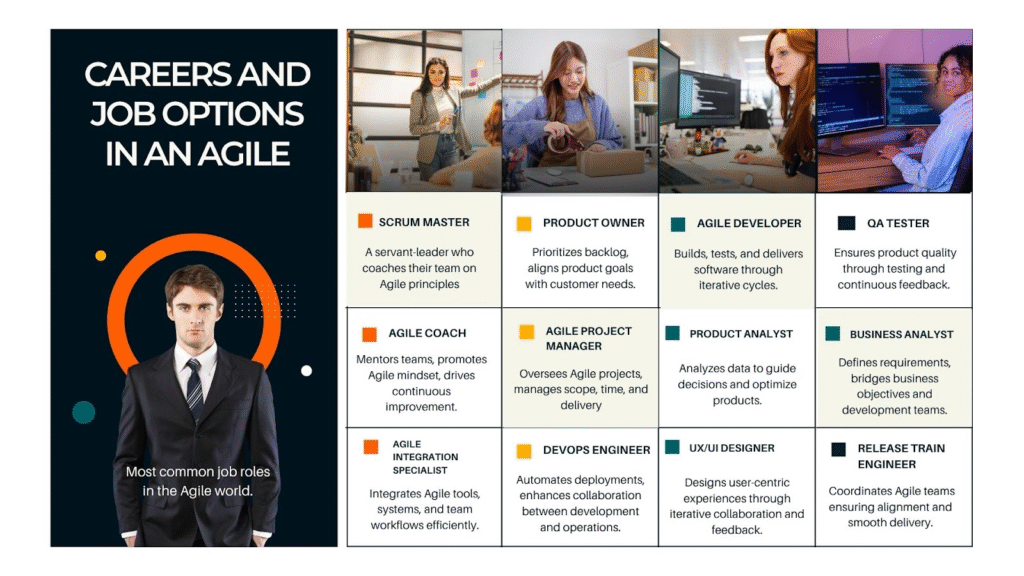
Careers and Job Options in an Agile Work Environment:
This agile methodology led to the evolution of existing job functions and the creation of new specialized roles across the industries. The following most common job roles in the Agile world.
Common Agile Interview Questions and How to Prepare for Them:
Agile roles interviews test your understanding of the Agile mindset and how you understand its principles. Before appearing for the interview, you must understand completely about the Agile concepts. Those are:
Some of the most common Agile Interview Questions every recruiter asks to test your knowledge.
Foundational Questions:
| Question | What Recruiters are Testing | Ideal Answers |
| What is Agile, in your own words? | Can you explain the mindset, not just the process. | “It’s a way of working that focuses on delivering small pieces of value to the customer frequently, getting their feedback, and adapting the plan based on that feedback. It’s more about being flexible and collaborative than following a rigid, long-term plan.” |
| What’s the difference between Agile and Waterfall? | Your understanding of why Agile was created. | “Waterfall is a linear, sequential approach where you complete each phase (like design, develop, test) fully before moving to the next. Agile is iterative; we build, test, and deliver in small, repeating cycles. This makes Agile better at handling changes.” |
| What are the values of the Agile Manifesto? | Do you know the core philosophy? | “The four values are: Individuals and Interactions over processes and tools. Working Software over comprehensive documentation. Customer Collaboration over contract negotiation. Responding to Change over following a plan.(It’s important to note that the items on the right are still valued, but the items on the left are valued more).” |
Scrum-Specific Questions:
| Question | What Recruiters are Testing | Ideal Answers |
| What are the roles, events, and artifacts in Scrum? | Your basic knowledge of the Scrum framework. | Roles: Product Owner, Scrum Master, and Developers. Events: Sprint, Sprint Planning, Daily Scrum, Sprint Review, Sprint Retrospective. Artifacts: Product Backlog, Sprint Backlog, Increment. |
| What is the purpose of a Daily Stand-up? | That you understand it’s a planning meeting, not a status report for the manager. | “It’s a short, time-boxed meeting for the developers to synchronize their work and create a plan for the next 24 hours. The three questions are a common format to facilitate this: What did I do yesterday? What will I do today? Are there any impediments?” |
| What is a Sprint Retrospective? | Your understanding of continuous improvement. | “It’s a meeting held at the end of each Sprint where the team reflects on how they worked and identifies one or two small, concrete improvements they can make to their process in the next Sprint. It’s the heart of the team’s ability to get better.” |
| What is the difference between a Product Backlog and a Sprint Backlog? | Your understanding of planning levels. | “The Product Backlog is the master, prioritized list of everything that might be needed in the product, owned by the Product Owner. The Sprint Backlog is the set of Product Backlog items selected for the current Sprint, plus a plan for delivering them, created by the Developers.” |
Behavioral & Situational Questions:
| Question | What Recruiters are Testing | Ideal Answers |
| What do you do if the team is not able to complete all the stories they committed to in a Sprint? | Your problem-solving and understanding of Scrum. | “First, it’s not considered a ‘failure,’ but a learning opportunity. During the Retrospective, we would discuss the reasons why. Was the commitment too ambitious? Were there unexpected impediments? Were the stories not well-defined? The goal is to understand the cause and adapt our process or forecasting for the next Sprint.” |
| How do you handle a situation where the Product Owner or a stakeholder wants to add a new, critical item in the middle of a Sprint? | Your understanding of the Sprint as a protected time-box and your negotiation skills. | “I would first acknowledge the importance of the new request. Then, I would explain that the Sprint goal is currently fixed to protect the team’s focus. We have two options: 1) The Product Owner can formally cancel the current Sprint (which is rare and disruptive), or 2) We note the new item, add it to the Product Backlog, and discuss its priority in the next Sprint Planning meeting.” |
| Tell me about a time you had a conflict within your team. How was it resolved? | Your teamwork, facilitation, and conflict resolution skills. | (Use the STAR method: Situation, Task, Action, Result). “On a previous project, two developers had a technical disagreement on an approach. My role was to facilitate a constructive discussion. I had them each list the pros and cons of their approach. We agreed to spike the most contentious part… The result was a hybrid solution everyone was happy with, and we delivered the feature successfully.” |
| What is the difference between a Product Backlog and a Sprint Backlog? | Your understanding of planning levels. | “The Product Backlog is the master, prioritized list of everything that might be needed in the product, owned by the Product Owner. The Sprint Backlog is the set of Product Backlog items selected for the current Sprint, plus a plan for delivering them, created by the Developers.” |
Choosing the CSM certification Course has a curriculum to crack the Scrum role and secrets of clearing agile roles through confidence interview performances.
The Secret to Standing Out in Agile Job Interviews:
Succeeding in an Agile interview needs more than just memorizing the Scrum guide or Agile Manifesto. Below, we come up with some tips and guidance on how to succeed in an Agile roles interview.
Interviewers rate candidates based on a scale from 1 (Low) to 5 (High) in below four areas.
- Knowledge
- Experience
- Coaching/Collaboration
- Humility and Team Focus
Tips to Stand Out in Interviews:
1. Treat the Interview as a Conversation:
Engage with interviewers’ questions and suggestions. For example, if the interviewer comes with a question, “ How does your team currently handle defects in a sprint? “ your answer should be “I can share an approach that helped my previous team reduce defects by 30%.”
2. Be Results-Oriented:
Avoid vague or generic answers. Instead, provide specific examples with measurable outcomes. Show how you helped a team improve practices, deliver faster, or increase product value.
3. Provide a 30-60-90 Day Plan:
Bring a proactive plan showing how you would approach the role if hired. Prepare two versions if unsure whether you will join a new or existing team:
- For a new team: Focus on building rapport, understanding processes, and identifying key pain points.
- For an existing team: Focus on optimizing practices, resolving bottlenecks, and delivering quick wins.
4. Show Adaptability and Agile Mindset:
Agile interviews often test thinking and problem-solving under uncertainty. Demonstrate your ability to: Respond to changing priorities, facilitate collaboration across distributed or cross-functional teams, and continuously inspect and adapt processes.
5. Communicate Clearly and Confidently:
Use the STAR method for behavioral questions. Speak in terms of impact on team, product, and organization, not just tasks performed. Balance humility with confidence, show that you lead by influence, not authority.
Conclusion:
At last, as a summary, keep in mind these takeaways: Understand the “why” behind Agile, not just the process. Show real-world application of Agile principles through examples. Demonstrate collaborative leadership, coaching ability, and humility. Be specific, data-driven, and results-focused. Research the organization’s Agile implementation to align your answers with their context. By combining deep knowledge, practical experience, and a results-focused mindset, you can stand out in Agile interviews for any role.
University of Houston graduate with 5 years of blogging experience, excelling in content strategy, SEO, and audience engagement. Connect with me on LinkedIn.