
Business
The AI Revolution in Business: Automating Marketing, Sales, an


Introduction: The Shift from Manual to Intelligent Operations

The business world is changing faster than ever. To stay competitive, companies must find more innovative ways to operate. This is where business automation becomes essential.
At its core, business automation uses technology to perform tasks and processes. These tasks once required human effort. It has significantly evolved, moving beyond simple scripts to incorporate advanced artificial intelligence. This evolution helps businesses boost productivity and gain a significant competitive advantage.
In this guide, we will explore what business automation truly means. We will look at how it has grown and the core technologies that drive it. We will also examine its many benefits. Finally, we will see how it is revolutionizing critical functions like marketing, sales, and IT. Understanding how to leverage modern AI business automation is key to success today.
The Core Technologies Driving Modern Business Automation
Business automation is not a single technology but a powerful convergence of several innovative tools and methodologies. At its heart, it’s about leveraging software to perform tasks that were traditionally manual, making operations faster, more accurate, and more scalable.
The foundation of modern business automation rests on several key technologies:
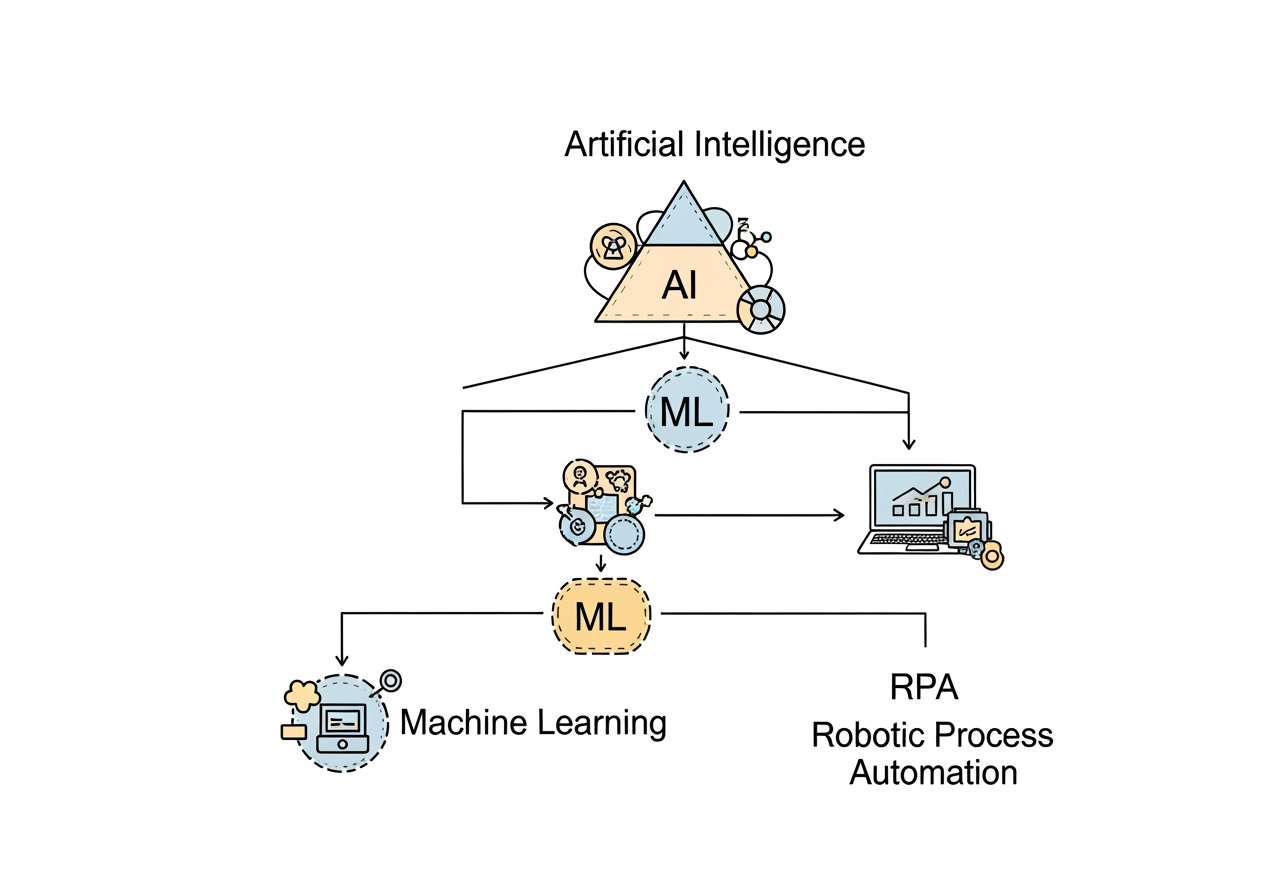
- Robotic Process Automation (RPA): RPA uses software robots, or “bots,” to mimic human interactions with digital systems. These bots can perform repetitive, rule-based tasks such as data entry, form filling, and navigating applications, just like a human would. RPA is particularly effective for automating processes across disparate systems without requiring complex API integrations.
- Business Process Management (BPM): a discipline that involves identifying, modeling, analyzing, measuring, improving, optimizing, and automating business processes. While RPA focuses on automating tasks, BPM aims to manage and optimize end-to-end workflows, often involving multiple systems and human touchpoints.
- Artificial Intelligence (AI): AI is the broader field that enables machines to perform tasks that typically require human intelligence. In automation, AI brings cognitive capabilities, allowing systems to learn, reason, and make decisions.
- Machine Learning (ML): A subset of AI, ML involves algorithms that enable systems to learn from data without being explicitly programmed. This allows automation tools to adapt to new patterns, make predictions, and improve performance over time.
- Natural Language Processing (NLP): Another crucial AI component, NLP enables computers to understand, interpret, and generate human language. This is vital for automating tasks involving unstructured data, such as customer service interactions, email analysis, and document processing.
These technologies often work in concert, creating robust automation solutions that go beyond simple task execution. For instance, an RPA bot might use NLP to extract data from an invoice and then use ML to categorize it before entering it into a BPM-managed workflow.
The Four Levels of AI-Powered Automation
As AI becomes more integrated into business processes, we see a clear progression in the sophistication of automation. This evolution can be categorized into four distinct levels, each building on the capabilities of the last:
- Basic Automation: This is the entry point for many organizations. It involves automating simple, repetitive, rule-based tasks that require minimal decision-making. Think of scheduled email sends, auto-generated reports, or basic data transfers between systems. These automations are typically straightforward and follow predefined scripts.
- Process Automation: Moving beyond individual tasks, this level focuses on automating entire workflows or sequences of tasks. This often involves BPM tools that orchestrate multiple steps, potentially across different departments or applications. While still largely rule-based, process automation can handle more complex sequences and dependencies, ensuring consistency and transparency in multi-step operations.
- Advanced Automation: At this level, automation begins to incorporate elements of AI to handle more complex scenarios that might involve decision-making, data interpretation, or personalization. Advanced automation combines human oversight with machine assistance. For example, an automated system might flag anomalies in financial transactions for human review, or an AI might suggest personalized product recommendations based on customer behavior. This level often leverages machine learning and natural language processing to process and understand more nuanced data.
- Intelligent Automation: The pinnacle of AI-powered automation. Intelligent automation systems can learn from data, adapt to new problems, and make independent decisions with minimal human intervention. They can process unstructured data, understand context, and even engage in predictive analytics to anticipate future outcomes. Examples include AI-powered virtual agents that resolve complex customer queries, systems that automatically optimize supply chains using real-time data, and platforms that generate detailed reports and insights without human intervention. Here, AI isn’t just assisting; it’s actively driving and optimizing processes.
AI’s role grows significantly with each level, moving from simple execution to intelligent decision-making and predictive capabilities. This progression allows businesses to tackle increasingly complex challenges and open up greater value from their automation initiatives.
Key Components of an Automation Stack
To effectively implement business automation, organizations need a robust and integrated automation stack. This stack comprises various technological and operational components working in harmony:
- Automation Software: The core of any automation initiative. It includes RPA platforms for task automation, BPM suites for workflow orchestration, and specialized AI/ML tools for cognitive capabilities such as natural language understanding and predictive analytics. Many modern platforms offer a combination of these functionalities, often with low-code/no-code interfaces to empower citizen developers.
- Hardware and Infrastructure: While much of modern automation runs in the cloud, the underlying hardware and infrastructure remain critical. This includes servers, cloud computing resources, networking capabilities, and sometimes specialized IoT devices that feed data into automation systems. Scalability and reliability of this infrastructure are paramount.
- API Integration and Middleware: For automation to be truly effective, it must integrate seamlessly with existing business systems, whether they are legacy applications or modern cloud services. Application Programming Interfaces (APIs) facilitate this communication, allowing different software components to exchange data and trigger actions. Middleware acts as a bridge, enabling integration between disparate systems that might not have native API compatibility.
- Data Security and Compliance Standards: As automation handles sensitive business data and processes, robust security measures are non-negotiable. This includes strong data privacy practices, secure data encryption (e.g., AES-256, FIPS-140 certified), and robust authentication and authorization mechanisms, often managed through Identity and Access Management (IAM) systems. Furthermore, adherence to industry-specific and global compliance standards, such as GDPR, ISO 22301, ISO 27001, SOC 1 Type 2, SOC 2 Type 2, and HITRUST, is critical. Organizations must ensure their automation solutions are built and operated in accordance with these regulations, and vendors should demonstrate their security posture through thorough risk assessments and compliance audits.
Together, these components form the backbone of a successful business automation strategy, enabling organizations to build, deploy, and manage automated processes securely and efficiently.
High-Impact Automation: Changing Marketing, Sales, and IT
Business automation is a game-changer across various departments, fundamentally altering how marketing, sales, and IT functions operate. By automating routine, repetitive, and data-intensive tasks, organizations can significantly boost departmental efficiency, streamline cross-functional workflows, and ultimately deliver a superior customer experience.

Automating Marketing for Personalization and Scale
Marketing has evolved from broad campaigns to highly personalized interactions. Automation is the engine driving this change, allowing businesses to engage with customers at scale while maintaining a personal touch.
- Email Marketing Automation: Tools automate the sending of personalized emails based on triggers like website visits, purchases, or inactivity. This includes welcome sequences, abandoned cart reminders, and re-engagement campaigns.
- Social Media Scheduling: Platforms allow marketers to plan, schedule, and publish content across various social media channels, ensuring a consistent online presence and freeing up time for engagement and strategy.
- AI Content Generation: With the rise of generative AI, tools such as large language models can assist in drafting marketing copy, blog posts, social media updates, and even email subject lines, significantly speeding up content creation. This frees up human marketers to focus on strategy and creativity.
- Lead Nurturing: Automated workflows guide leads through the sales funnel, providing relevant content and interactions at each stage, qualifying them for sales teams.
- Audience Segmentation and A/B Testing: Automation tools can dynamically segment audiences by behavior and demographics, enabling highly targeted campaigns. They also facilitate A/B testing of different messages or visuals to optimize campaign performance without manual oversight.
Effective marketing relies on consistency and personalization, two areas where automation delivers significant results. By automating these processes, marketing teams can focus on strategic initiatives, creative content, and deeper customer insights, thereby improving campaign performance and customer engagement. You can explore the broader implications of AI in digital marketing through our guide to the power of AI.
Streamlining Sales with Intelligent Business Automation
Sales processes are ripe for automation, as they often involve numerous repetitive tasks that can distract sales professionals from their core mission: building relationships and closing deals. Intelligent business automation empowers sales teams to be more efficient, responsive, and effective.
- CRM Automation: Customer Relationship Management (CRM) systems with built-in automation can streamline essential sales tasks such as lead tracking, pipeline management, and follow-ups. This ensures no lead falls through the cracks and that customer interactions are consistently managed.
- Automated Lead Scoring: AI and machine learning can analyze lead data to assign scores, helping sales teams prioritize high-potential prospects and focus their efforts where they matter most. This is a crucial step in the automated lead generation guide.
- Pipeline Management: Automation can update deal stages, trigger alerts for overdue tasks, and provide real-time visibility into the sales pipeline, ensuring smooth progression from prospect to customer.
- Sales Forecasting: AI-driven analytics can predict future sales trends based on historical data, market conditions, and pipeline activity, enabling more accurate planning and resource allocation.
- Automated Follow-ups: From initial contact to post-sale check-ins, automated email sequences and reminders ensure timely communication with prospects and customers, nurturing relationships without manual effort.
By offloading mundane tasks, sales professionals can dedicate more time to strategic selling, personalized outreach, and complex negotiations. This shift not only boosts productivity but also improves job satisfaction. In fact, robotic process automation can save finance teams as many as 25,000 hours of redoing work due to human error, and similarly, sales teams benefit immensely. Employees involved in high-impact RPA use cases save an average of 200 hours per year, allowing them to focus on more valuable activities. Leveraging AI business automation transforms sales operations from reactive to proactive, driving higher conversion rates and stronger customer relationships.
Optimizing IT Operations and Security
IT departments are often burdened with managing complex infrastructures, responding to helpdesk tickets, and ensuring robust cybersecurity. Business automation provides critical solutions to these challenges, enhancing efficiency, reliability, and security.
- Automated Helpdesk Support: Chatbots and virtual assistants can handle common IT support queries, provide immediate answers, and route complex issues to human agents, reducing response times and freeing up IT staff.
- AIOps (Artificial Intelligence for IT Operations): AIOps platforms use AI and ML to analyze vast amounts of operational data, identify patterns, predict potential issues, and automate responses. This allows for proactive problem-solving rather than reactive troubleshooting.
- Proactive Monitoring and Alerting: Automated systems continuously monitor network performance, server health, and application availability, triggering immediate alerts or even self-healing actions when anomalies are detected.
- Security Threat Detection and Response: AI-powered security tools can analyze network traffic, user behavior, and threat intelligence to detect and respond to cyber threats in real-time, often before human security analysts can intervene. This includes automated vulnerability scanning and patch management.
- Patch Management and Software Deployment: Automation streamlines the deployment of software updates and security patches across an organization’s entire IT infrastructure, ensuring systems are always up to date and protected against known vulnerabilities.
By automating these critical IT functions, organizations can achieve greater operational stability, reduce human error, and significantly improve their security posture. This not only improves service delivery but also allows IT professionals to focus on strategic initiatives and innovation. For comprehensive support in this area, exploring specialized Netsurit business automation solutions for IT infrastructure can provide custom expertise and tools.
A Strategic Roadmap for Implementing and Scaling Automation
Implementing business automation effectively requires more than just acquiring software; it demands a strategic approach, careful planning, and a focus on organizational change. A well-defined roadmap ensures that automation initiatives deliver tangible value and scale successfully across the enterprise.
Step 1: Identify and Prioritize Processes
The first crucial step is to pinpoint which processes are the best candidates for automation. Not every method is suitable; strategic selection maximizes impact and ROI. Look for processes that exhibit the following characteristics:
- Repetitive Tasks: Any task performed frequently and consistently is a prime candidate. This includes data entry, report generation, and routine approvals.
- High-Volume Processes: Processes that handle a large number of transactions or instances can yield significant time and cost savings when automated.
- Rule-Based Workflows: Processes that follow clear, logical rules and require minimal subjective judgment are easier to automate. If-then statements are a good indicator.
- Error-Prone Tasks: Manual processes are susceptible to human error. Automating these can drastically improve accuracy and consistency, reducing rework and associated costs.
- Time-Sensitive Tasks: Processes that require quick turnaround times or have strict deadlines can benefit from automation’s speed and reliability.
- Processes with Multiple Hand-offs: Workflows involving many different people or departments often suffer from delays and communication breakdowns. Automation can streamline these hand-offs.
Tools such as process mining and task mining can help uncover these opportunities by analyzing existing workflows and identifying bottlenecks and inefficiencies. Starting with “quick wins”—processes that are easy to automate and deliver immediate, measurable benefits—can build momentum and demonstrate the value of automation to stakeholders.
Step 2: Develop Your Business Automation Strategy
Once potential processes are identified, the next step is to craft a comprehensive implementation and scaling strategy.
- Start Small with Pilot Projects: Rather than attempting a massive overhaul, begin with small, manageable pilot projects. This allows teams to gain experience, refine processes, and demonstrate success without significant risk.
- Define Clear Goals (KPIs): For each automation initiative, establish specific, measurable, achievable, relevant, and time-bound (SMART) goals. These Key Performance Indicators (KPIs) might include reduced process time, decreased error rates, cost savings, or improved customer satisfaction.
- Choose the Right Platforms: Select automation tools and platforms that align with your business needs, existing infrastructure, and long-term vision. This involves evaluating various RPA, BPM, and AI solutions. For organizations seeking comprehensive, AI-driven capabilities, choosing a solution like Truvix AI business automation c