
Latest News
Retirement Planning for Every Stage of Life


Key Takeaways
- Start saving as early as possible to maximize the benefits of compound interest.
- Modify your investment strategy as you approach retirement to reduce risk.
- Include long-term healthcare and evolving legislative factors in your retirement plan.
- Stay informed about recent laws and policies that affect retirement savings and withdrawals.
Retirement planning Wyckoff, NJ, is not a one-time event but an ongoing journey that evolves as you progress through each phase of life. Your twenties, mid-career years, pre-retirement stage, and post-retirement period each present distinct opportunities and challenges that require personalized strategies. By creating a plan early and reviewing it regularly, you ensure your future security and flexibility.
As the retirement landscape shifts with new economic realities and legislative updates, staying informed and proactive becomes increasingly important. By understanding the key decisions at each stage, you maximize your financial stability and can face your retirement years confidently and comfortably.
Early Career: Laying the Foundation
In your twenties and thirties, the most powerful step you can take is simply to start saving. Time is your greatest ally because the effects of compound interest become significant over several decades. Automating your savings and taking advantage of tax-advantaged accounts are vital steps to establishing a solid foundation for the future.
- Participate in Employer-Sponsored Plans: Enroll in workplace 401(k) plans, especially if the employer offers matching contributions. Ignoring a match is leaving free money on the table.
- Explore IRAs: Open a Roth or Traditional IRA to boost your tax-efficient savings outside of your employer plan.
- Automate Contributions: Set up consistent, automated transfers to make saving effortless and to develop a strong savings habit.
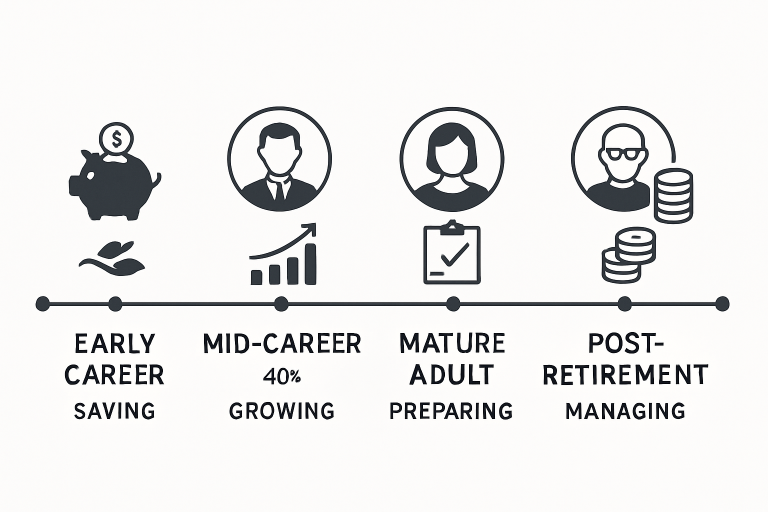
Mid-Career: Accelerating Savings
The mid-career phase (forties and fifties) is often when earnings peak, and competing financial priorities, such as children’s education or mortgage payments, become more intense. This is the time to take advantage of higher income levels to maximize savings and diversify investments for a balanced portfolio. You can also evaluate health-related savings that will benefit you later.
- Increase Contributions: If you are 50 or older, take advantage of catch-up contribution provisions for 401(k)s and IRAs.
- Diversify Wisely: Rebalance your portfolio periodically by maintaining an appropriate mix of stocks, bonds, and alternative investments. Diversification helps weather market volatility and protects your growing nest egg. You can find more about effective asset allocation at Investopedia’s asset allocation guide.
- Plan for Medical Expenses: Consider Health Savings Accounts (HSAs) for their triple tax advantages and potential to cover medical costs in retirement.
Pre-Retirement: Fine-Tuning Your Plan
As you approach your late fifties and early sixties, clarity and precision become crucial. This is the period to estimate your retirement spending, minimize debt, and ensure that your legal documents reflect your intentions. By doing so, you set the stage for a smooth transition into retirement and protect both your resources and your loved ones.
- Assess Your Retirement Budget: Analyze all possible expenses, from housing and healthcare to hobbies and travel.
- Eliminate Debt: Prioritize paying off high-interest debts before you retire to improve your cash flow and reduce financial stress.
- Update Estate Planning: Review wills, powers of attorney, living wills, and beneficiaries to avoid unnecessary complications.
Post-Retirement: Managing Your Resources
After you have retired, the focus shifts to managing withdrawals and adapting to new circumstances. Keep your withdrawal rate sustainable, reassess your investment portfolio for lower risk, and stay vigilant about changes in tax policy or Social Security benefits that may affect your income.
- Develop a Withdrawal Strategy: Use guidelines such as the 4% rule to avoid depleting your savings prematurely while supporting your lifestyle.
- Continue Portfolio Oversight: Regularly review your portfolio and make adjustments to keep pace with market realities and personal needs.
- Stay Current: Keep track of legislative and tax changes from trusted authorities such as the IRS Retirement Plans section.
Incorporating Long-Term Care Planning
Long-term care is a crucial piece of retirement planning, yet it is often neglected. According to the U.S. Department of Health and Human Services, most adults over 65 will require some form of long-term care. Early planning can ease financial challenges and reduce stress on your family.
- Long-Term Care Insurance: Explore insurance options that help mitigate the high costs of nursing homes, assisted living, or home care.
- Understand Public Programs: Learn what Medicare and Medicaid offer, their limitations, and eligibility requirements for various care services.
- Family Communication: Engage your loved ones in open discussions about your preferences and expectations for care.
Staying Updated on Legislative Changes
Retirement planning does not stop once you are retired. Laws continually change. For example, the SECURE 2.0 Act in 2022 brought new rules for retirement savers, including adjustments to required minimum distributions, expanded automatic enrollments, and higher catch-up contributions. That is why it is essential to stay informed and adjust your strategies as needed to take advantage of new opportunities.
- Required Minimum Distributions (RMDs): The age for mandatory withdrawals from tax-advantaged accounts has been pushed back, allowing more years of tax-deferred growth.
- Workplace Plan Improvements: New laws promote higher participation through automatic enrollment.
- Catch-Up Contributions: Enhanced allowances help late savers bolster their retirement savings as they near retirement age.
Conclusion
Effective retirement planning is a continuous process that requires discipline, regular evaluation, and adaptation to personal and legislative changes. By building healthy saving habits early, fine-tuning your strategy as your life evolves, and staying informed about legal updates, you will enhance your chances of a secure, comfortable, and fulfilling retirement.