
General
Reliable Vertical Access Solutions for Secure High-Level Work

Key Takeaways
- Traditional ladders create unnecessary safety risks and reduce workplace efficiency.
- Advanced vertical access equipment, such as low-level access lifts and automated storage solutions, delivers measurable improvements in safety, ergonomics, and productivity.
- Upgrading vertical access methods is an investment in both worker protection and long-term organizational success.
Vertical access is a core requirement in construction, manufacturing, warehousing, and facility management. While many workplaces still rely on ladders to reach higher areas, advances in technology have made it far easier and safer to perform elevated work without the traditional risks. As industries continue to pursue higher productivity and improved safety, modern Man Lifts and vertical access systems represent a significant step forward for facilities of all sizes.
The importance of investing in safe and efficient vertical access solutions cannot be overstated. With the right equipment and infrastructure in place, businesses reduce injuries, support regulatory compliance, and streamline workflow at every level. Focusing on these modern alternatives not only protects workers but also helps organizations realize lasting benefits, including enhanced productivity and lower operating costs.
Today’s managers and safety officers face a wide array of choices for vertical access. Knowing the advantages and key considerations of each solution makes it easier to select the right fit for different facility types and job requirements. For businesses looking to address their increased workloads, keeping up to date with occupational safety standards and modern vertical access systems is key. A helpful overview of workplace fall hazards can be found at the OSHA Fall Protection Resource Page.
Risks of Traditional Ladders
Though commonly used, traditional ladders pose significant risks in the workplace. According to the U.S. Bureau of Labor Statistics, falls from ladders make up a large portion of work-related injuries and fatalities each year. Instability while climbing, limited mobility while working at height, and the physical strain of ascending or descending ladders all increase the potential for serious accidents and worker fatigue.
When employees rely on ladders for repetitive or prolonged access, there is often little opportunity for ergonomic positioning. Tasks require one-handed work for stability, increasing the risk of dropped tools or poor artistry. Businesses feeling the impact of these risks will often see higher healthcare costs, increased workers’ compensation claims, and lost productivity during accident investigations or worker absences. For an in-depth look at ladder accident statistics and preventive measures, readers may find the CDC’s Fall Prevention Topic Page insightful.
Low-Level Access Lifts
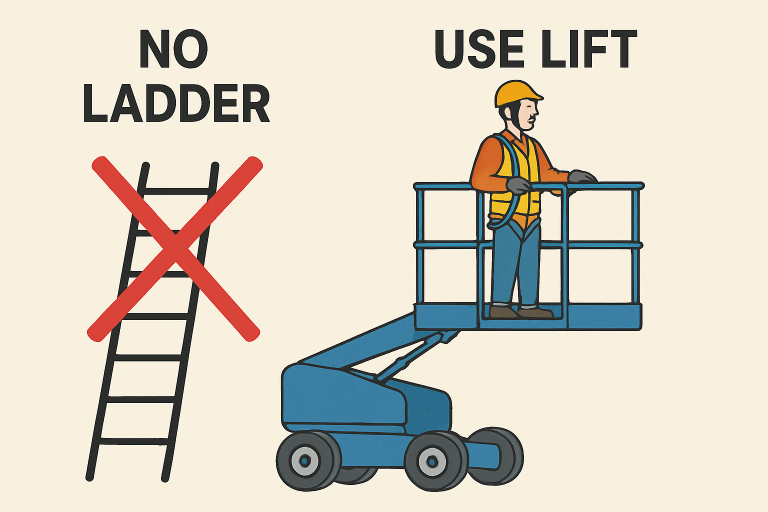
Low-level access lifts offer a modern alternative to portable ladders. These mechanical lifts provide secure platforms that can be raised or lowered to the desired working height. Unlike ladders, which often require hands-on climbing, lifts such as the JLG 1230P push-around model allow for hands-free operation and a stable, enclosed workspace. Operators can reach heights over 17 feet and safely handle equipment weighing up to 440 pounds.
Advantages of Modern Lifts
- Greater stability and safety through enclosed workspaces or guardrails
- Less physical strain and reduced worker fatigue compared to repetitive ladder climbs
- Improved productivity as tools and materials can be transported safely on the platform
- Highly maneuverable for positioning in tight spaces, contributing to faster job completion
Automated Storage Systems
Automated storage and retrieval systems (ASRS) are transforming warehouse and manufacturing environments. Vertical lift modules (VLMs) maximize vertical space, enabling businesses to store materials in high-density configurations. Rather than requiring employees to climb to high shelves, these systems use software-controlled elevators to bring materials to an ergonomic height for picking and placement. This optimizes floor space and dramatically reduces the frequency of worker movement to hazardous locations.
Impact on Workplace Efficiency
By automating access to storage, ASRS reduces manual labor demands and lowers the risk of falls or strains. Hand-picking from shelves at various heights is replaced by error-reducing automation, resulting in quicker order fulfillment and better inventory control. These solutions are especially beneficial for facilities with high SKU counts or fluctuating throughput demands, as automation can easily scale up or down.
Vertical Lifeline Systems
When ladders or vertical climbing cannot be avoided, vertical lifeline systems offer continuous protection. These engineered safety systems feature cables or rails installed alongside access paths. Workers wear harnesses that attach to locking mechanisms, ensuring that a slip or misstep results in immediate arrest rather than a potentially fatal fall. Vertical lifeline systems maintain freedom of movement while providing peace of mind for workers operating at height.
Applications Across Industries
Industries working on towers, wind turbines, telecommunications, and large-scale facility maintenance benefit significantly from integrating vertical lifeline systems. These safety solutions help companies meet regulatory requirements and demonstrate a commitment to worker well-being. Integrating lifeline systems also simplifies site-specific safety training, as workers learn to trust the consistency and reliability of advanced fall-prevention technology.
Raised Access Floors
Although not a direct alternative to traditional ladders, raised access floors create safer, more flexible workplaces. By elevating the office or production floor, these systems make it easy to run cables, pipes, and utilities beneath the surface, minimizing tripping hazards and creating space for rapid infrastructure changes as needs evolve.
Benefits for Modern Workplaces
Raised access floors enhance aesthetics, enable quick reconfiguration of electronics or mechanical systems, and support the implementation of advanced HVAC solutions. As companies upgrade to support digital tools and improved air quality, raised floors make these transitions seamless, minimizing disruptions to operations. The result is a workspace that is both more organized and comfortable for employees, contributing to overall productivity and satisfaction.
Conclusion
Modernizing vertical access strategies yields significant advantages for today’s workforce. Moving beyond traditional ladders and adopting solutions such as low-level access lifts, automated storage systems, vertical lifeline systems, and raised access floors not only improves safety but also supports long-term productivity and regulatory compliance. As industries continue to evolve, investments in advanced vertical access solutions will remain a critical factor in creating secure and efficient working environments.