
Tech
Innovative Approaches to Modern Metal Fabrication Techniques

Modern metal fabrication has seen a rapid transformation as technological advances shape how manufacturers meet increasing demands for precision, efficiency, and sustainability. Businesses across industries, from aerospace to automotive, are investing in forward-thinking approaches to stay competitive and environmentally responsible. For those who want the latest insights into custom fabrication and welding, companies like Elite Weld & Fab exemplify the expertise and technology driving this progress today. Exploring these new methods can help industry stakeholders make informed decisions, boost output, and optimize quality while reducing waste.
With customers expecting higher-quality products and faster turnaround times, manufacturers must continually evaluate the most effective metal fabrication techniques to remain at the forefront of innovation. Computer-driven automation, innovative welding systems, and sustainable processes are just a few changes making significant impacts. This shift is not only about achieving better results but also about shaping a more resilient, sustainable manufacturing landscape for future generations. Staying informed about developments is crucial for anyone participating in the metal fabrication sector.
The emergence of advanced fabrication approaches is also tightly connected to supply chain agility and product innovation. Businesses turning to these processes gain opportunities for more flexible production schedules, lower costs, and less resource-intensive manufacturing. This results in a stronger foundation for both large-scale manufacturers and custom prototyping shops. As these approaches become increasingly standard, understanding their strengths is vital for long-term business success.
In addition, the broad impacts of these innovations are reflected in industry research and analysis from outlets like Manufacturing Tomorrow, which highlight the pace and variety of modern fabrication advances.
Additive Manufacturing
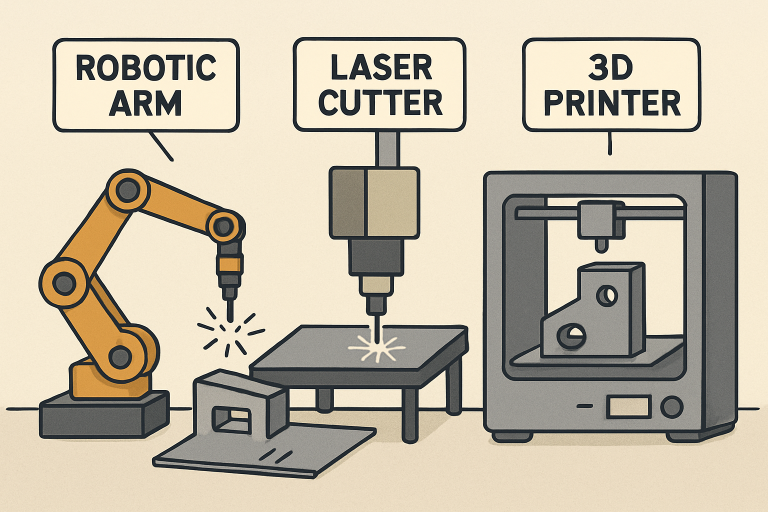
Additive manufacturing, often referred to as 3D printing, is revolutionizing the design and production of metal components. This process builds parts layer by layer from digital models, allowing for intricate geometries and customizations that were previously unfeasible or too expensive with traditional subtractive methods. Industries such as aerospace, healthcare, and automotive take advantage of these capabilities to create lightweight, high-performance components while reducing material waste. The flexibility to rapidly prototype and develop parts accelerates innovation cycles and reduces time-to-market. According to research by Machine Design, the market for metal direct additive manufacturing continues to expand as its applications broaden.
Laser Cutting and Welding
Precision and productivity are hallmarks of modern laser cutting and welding. High-powered lasers can cut through thick metals with remarkable accuracy, leaving clean edges and minimizing post-processing requirements. Laser welding similarly delivers strong, precise joints while reducing heat input, which helps prevent distortion in sensitive applications. These technologies are invaluable when working with complex parts or high-strength materials, enabling fabricators to meet exacting standards and intricate designs. In many facilities, integrating laser systems has led to significant reductions in lead times and production costs.
Robotic Automation
The adoption of robotics in metal fabrication is transforming entire production lines. Tasks like welding, cutting, and part handling can be performed with consistent accuracy around the clock, minimizing human error and enhancing workplace safety. Robots help manufacturers scale up operations without a corresponding increase in labor costs or the risk of repetitive strain injuries among workers. With embedded sensors and smart controls, robotic systems provide valuable performance data, enabling operators to fine-tune processes continuously. This is, therefore, a cornerstone for both high-volume fabrication and specialized component assembly.
Hydroforming
Hydroforming replaces traditional stamping methods with high-pressure hydraulic fluid to shape metal sheets. This process creates complex shapes with uniform thickness and enhanced structural integrity. Common in the automotive and aerospace sectors, hydroforming significantly reduces the need for welding and mechanical fasteners, thereby producing lighter, stronger parts. The result is not only better product performance but also savings in assembly time and material usage. Hydroforming’s ability to achieve seamless, smooth surfaces with minimal defects has made it a go-to solution for manufacturers seeking to push the boundaries of design and functionality.
Cold Spray Additive Manufacturing
Cold Spray Additive Manufacturing (CSAM) is transforming how critical repairs and new components are fabricated. In CSAM, metal powders are blasted onto a substrate at high speed to build layers without melting. This unique process minimizes thermal distortion and preserves the material’s inherent properties, making it especially useful for sensitive aerospace and defense applications. Beyond repairs, cold spray is increasingly adopted in industries seeking high-performance coatings or specialized component fabrication. The solid-state nature of CSAM makes it an energy-efficient alternative to other methods, reducing both lead times and environmental impact.
Sustainable Practices
Sustainability is a growing focus among modern metal fabricators. Recycling scrap materials, implementing energy-efficient equipment, and adopting eco-friendly surface treatments are just a few initiatives gaining ground. Some facilities integrate solar or wind power into their operations, while others optimize workflows to minimize energy usage. These efforts not only help reduce the industry’s carbon footprint but also often result in cost savings for manufacturers and their customers. As highlighted by the U.S. Environmental Protection Agency, sustainable management of metals is shaping the industry’s future.
Conclusion
Modern metal fabrication stands at the intersection of technology, innovation, and sustainability. By embracing additive manufacturing, precise laser techniques, advanced automation, and environmentally conscious operations, fabricators are well-positioned to meet the evolving needs of global industries. These approaches foster not only improved efficiency and quality but also resilience against future manufacturing challenges.