
NEWS
Common Label Printing Problems and Reliable Fixes

Key Takeaways
- Understanding common label printing issues is essential for maintaining product quality and brand reputation.
- Implementing preventive measures and regular maintenance can significantly reduce the likelihood of these problems occurring.
- Choosing the right materials and equipment plays a crucial role in achieving optimal label printing results.
Label printing is essential to packaging, inventory management, and branding, as even minor issues with printed labels can impact professionalism and operational efficiency. Problems often arise from equipment, materials, or environmental conditions, but can be addressed through early detection and effective practices. Maintaining print quality ensures legibility, reduces waste, and upholds brand consistency. Proactive measures, such as regular maintenance, operator training, and selecting the right materials, help prevent errors like smudging or color mismatches. Understanding key variables allows for quicker troubleshooting and consistent results across production.
1. Blurry or Fuzzy Print
Problem
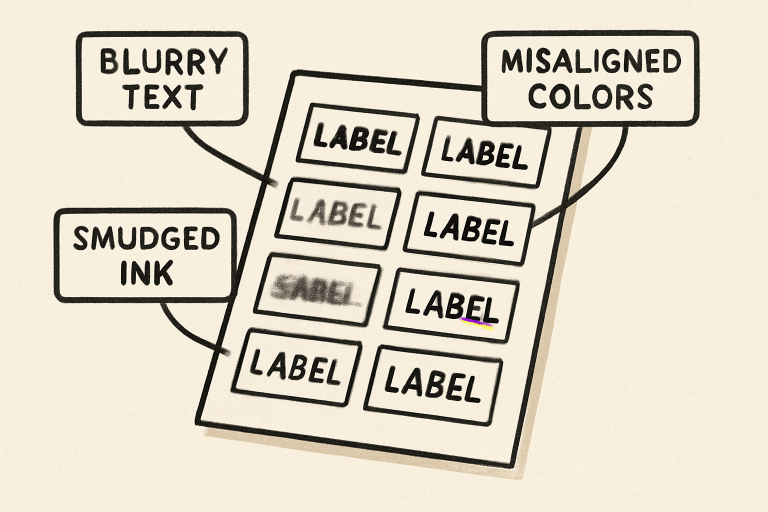
Labels appear out of focus, with text and images lacking sharpness, which diminishes readability and perceived product value.
Causes
- Suboptimal printing plate quality
- Incorrect ink viscosity
- Improper impression pressure between the plate and substrate
Solutions
- Use high-resolution printing plates to ensure sharp edges and consistent relief depth
- Adjust ink viscosity to match both substrate and press speed
- Refine the pressure applied between the plate and the substrate for clean ink transfer
2. Inaccurate Color Matching
Problem
Printed label colors do not consistently match brand guidelines or exhibit noticeable shifts between print runs.
Causes
- Inconsistent ink formulation
- Varying substrate absorption rates
- Incorrect anilox roller specifications
Solutions
- Adopt a rigorous color management workflow and standardized ink systems
- Choose substrates with coating and absorption properties tailored for printing
- Use anilox rollers with the optimal line count (LPI) and cell volume for the proper color density
3. Registration Misalignment
Problem
Color layers or design elements appear misaligned, creating a ghosted effect that impacts aesthetics and barcode readability.
Causes
- Mechanical instability within press components
- Improper web tension throughout the print cycle
- Plate mounting errors
Solutions
- Maintain and calibrate alignment systems, gears, and servo drives regularly
- Use automatic tension control for continual web alignment
- Utilize advanced plate mounting with micro-adjustment features
4. Ink Smudging or Slow Drying Time
Problem
Labels exhibit smudged ink or remain tacky, leading to handling issues and product rejections.
Causes
- Over-application of ink
- Poorly functioning or inadequate drying system
- Ink formulations incompatible with the press or substrate
Solutions
- Optimize ink laydown volume to prevent over-saturation
- Install or upgrade drying systems and perform routine maintenance
- Select inks formulated to cure rapidly on your chosen substrate
5. Wrinkles or Web Curling
Problem
Curling and wrinkles in label stock lead to application failures and difficulty during automated label dispensing.
Causes
- Incorrect or inconsistent web tension
- Inappropriate substrate thickness
- Poor roll alignment
Solutions
- Adjust tension using automatic controls and set careful winding parameters
- Install or calibrate anti-wrinkle rollers and web guides
- Ensure rolls are loaded flat to prevent uneven tension and distortion
6. Label Edge Lifting or Poor Adhesion
Problem
Labels lift at the edges or fall off their surfaces, causing product misidentification or poor aesthetic results.
Causes
- Improper die-cut settings causing incomplete cuts
- Adhesive not matched to application surface or environment
- Insufficient lamination pressure
Solutions
- Dial in die-cut depth precisely to prevent cutting through liners
- Select adhesives tested for your surface and environment requirements
- Enhance lamination process to apply even, adequate pressure across labels
7. Uneven Ink Coverage
Problem
Some sections appear lighter, darker, or streaked—undermining the professional finish of the label.
Causes
- Dirty or clogged anilox rollers
- Blocked ink chamber
- Poor doctor blade maintenance
Solutions
- Establish a routine cleaning and inspection schedule for rollers and chambers
- Replace and maintain doctor blades appropriately
- Regularly check ink pH and viscosity
8. Static Electricity Problems
Problem
Labels can stick together, attract dust, or cause jams due to static charges, disrupting production lines.
Causes
- Low humidity or dry air conditions
- High-speed printing on synthetic materials
Solutions
- Use static eliminators or ionizing bars strategically on equipment
- Control pressroom humidity to optimal levels
- Consider substrates with inherent anti-static properties
9. Label Misplacement on Reels
Problem
Labels are not consistently positioned on finished reels, impacting automated application systems and customer expectations.
Causes
- Poor web slitting accuracy
- Misaligned die-cut units
- Unreliable rewinding tension
Solutions
- Upgrade slitting systems with accurate optical edge tracking
- Calibrate die-cutters frequently to ensure image and cut alignment
- Use rewinding systems with precise, adjustable tension control
10. Frequent Machine Downtime
Problem
Label press equipment experiences unplanned halts, impacting delivery schedules and operational efficiency.
Causes
- Skipping preventive maintenance
- Worn, low-quality components
- Operator skill gaps
Solutions
- Stick to a strict preventive maintenance plan and log all repairs
- Invest in high-quality, durable machinery and replacement parts
- Train staff regularly to build technical expertise and best practices
By understanding and proactively remedying these common issues, businesses not only maintain the visual and functional quality of their printed labels but also reduce rework, maintain productivity, and uphold a strong brand presence in the market. As highlighted in Packaging Technology Today, addressing labeling problems such as misalignment, poor adhesion, or print smudging requires a combination of quality materials, proper equipment settings, and regular maintenance to ensure consistent, high-performance results.
Ultimately, investing in the proper labeling solutions translates to smoother operations and a more reliable product presentation. In an increasingly competitive market, flawless labeling can be a quiet but powerful advantage.