
HEALTH
How PCR Is Revolutionizing Infectious Disease Diagnostics


Key Takeaways
- PCR technology offers rapid and accurate detection of infectious agents, enhancing early diagnosis and treatment.
- Advancements like point-of-care PCR devices make diagnostics more accessible, even in remote areas.
- Integration with technologies like CRISPR and AI is expanding PCR’s disease detection and management capabilities.
The Role of PCR in Modern Diagnostics
The Polymerase Chain Reaction (PCR) is revolutionizing infectious disease diagnostics by allowing early identification of pathogen-specific DNA or RNA. This technology allows for prompt treatment and targeted care, ensuring patients receive the most appropriate therapies from the onset, making it a cornerstone of modern healthcare. It is central to the work of innovators like Countable Labs, a leader in advancing accessible molecular diagnostics to broader populations. PCR diagnostics are crucial for public health organizations to detect real-time outbreaks, implement containment measures, and protect vulnerable groups from disease threats. They also monitor antimicrobial resistance, guiding interventions and research. As PCR technology evolves, its efficiency, reliability, and adaptability strengthen its role in clinical diagnostics and global health initiatives.
Advancements in Point-of-Care PCR Testing
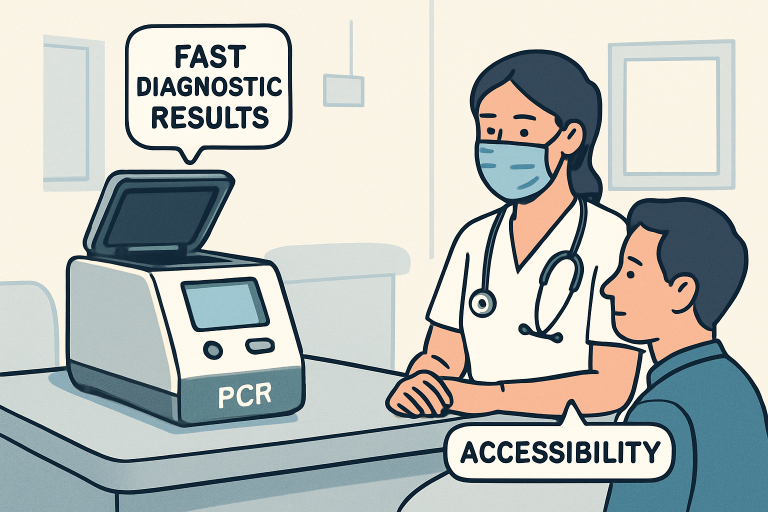
The evolution of PCR into a point-of-care (POC) testing platform has fundamentally democratized diagnostic access. Cutting-edge portable PCR systems now bring the power of laboratory-grade molecular diagnostics to the patient, whether at a clinic, pharmacy, or remote field site. These compact devices deliver highly accurate test results in under an hour—sometimes in as little as 20 minutes—which is crucial for diseases that spread rapidly or require swift intervention. The urgency and widespread impact of the COVID-19 pandemic highlighted just how vital these portable PCR solutions can be, both for patient outcomes and public health at large.
Benefits of Portable PCR Devices
- Speed: Receiving diagnostic results within minutes allows healthcare professionals to make timely decisions regarding patient isolation, treatment, and broader outbreak containment.
- Accessibility: The ability to test patients wherever they are—eliminating the challenges of centralized lab access—ensures that timely diagnostics are available to rural, resource-limited, and underserved communities.
- Simplicity: User-friendly PCR devices are designed for quick set-up and operation by non-specialists, streamlining workflow and reducing reliance on highly trained laboratory personnel.
Integrating POC PCR technology into primary healthcare settings means all communities can benefit from rapid, reliable infectious disease testing, no matter how remote. These advancements have set a new standard for global diagnostics, breaking barriers that once limited life-saving technologies to urban and affluent regions.
Integration with CRISPR Technology
A new era of diagnostic accuracy has arrived with the combination of PCR technology and CRISPR, a revolutionary tool renowned for its gene-editing and sequence-recognition capabilities. When integrated with PCR, CRISPR technology takes specificity and sensitivity to unprecedented levels, offering ultra-precise detection of pathogens, including newly emerging or notoriously difficult to identify using conventional methods. This synergy opens the door to diagnosing complex, evolving diseases earlier, facilitating better outbreak management and more informed clinical decisions.
Case Example: Emerging Diseases
During the global health crises caused by Zika, Ebola, and, most recently, SARS-CoV-2, PCR-CRISPR hybrid platforms proved their versatility and efficiency. These tests can detect genetic material from pathogens at extremely low concentrations, ensuring even asymptomatic cases are identified swiftly. Such advanced screening is critical for containing outbreaks and protecting high-risk populations. According to the National Center for Biotechnology Information (NCBI), CRISPR-enabled PCR platforms offer speed, adaptability, and superior accuracy compared to many traditional assays, making them indispensable in well-equipped labs and low-resource environments. The promise of CRISPR-enhanced diagnostics is not limited to pathogen detection; it also facilitates the identification of mutations responsible for drug resistance or changes in disease virulence, supporting rapid and personalized treatment strategies.
Artificial Intelligence and PCR Diagnostics
Artificial Intelligence (AI) is revolutionizing PCR-based diagnostics by automating data interpretation and improving overall test precision. Advanced algorithms process vast datasets in real time, identifying subtle patterns, anomalies, or co-infections that manual analysis might miss. AI-driven systems minimize error and reduce diagnostic times, which is vital when labs face a surge in testing volume or work under strained conditions. Furthermore, the integration of AI can continuously refine PCR workflows, made possible by the learning power of machine learning technologies.
Enhancing Diagnostic Workflow
- Data Processing: Machine learning models can rapidly interpret complex PCR output, flagging potential issues and guiding timely follow-up measures.
- Pattern Recognition: AI excels at detecting subtle genetic signatures or epidemiological trends—insights that fuel more accurate public health responses and enable earlier containment of evolving outbreaks.
- Continuous Improvement: Machine learning continually updates itself with new data, making PCR-based diagnostics more intelligent, more adaptive, and less reliant on manual recalibrations over time.
The marriage of AI with PCR propels the diagnostic field forward, underpinning the shift to precision medicine and personalizing infectious disease management. As these intelligent tools become further ingrained in clinical practice, the capacity for fast, confident diagnosis and treatment will only expand.
Challenges and Future Directions
Despite the immense progress PCR has brought to infectious disease diagnostics, several persistent hurdles remain. The initial cost for instruments and reagents, and the need for trained personnel and specialized infrastructure, can restrict access in lower-income regions or emergencies. Ensuring consistent sample quality—especially in the hands of less-experienced users—is another challenge that can impact the accuracy of results. Additionally, while PCR is renowned for detecting specific pathogens, traditional workflows can be less efficient for simultaneous, broad-spectrum pathogen detection.
Addressing Barriers to Access
To surmount these challenges, researchers and biotech firms are working to create next-generation PCR systems that are affordable, portable, and easy to use. Advances in microfluidic technology and smartphone-based PCR readers are making it possible to deploy high-quality molecular diagnostics virtually anywhere. Automation and user-friendly designs minimize operator error and ensure more reliable, standardized results. There is also a growing trend toward multiplex PCR, allowing multiple pathogens to be tested from a single patient sample. This development can dramatically improve outbreak surveillance and response. Looking ahead, the convergence of PCR with next-generation sequencing, biosensors, and cloud-based data analysis platforms promises to create comprehensive disease diagnostics capable of monitoring current threats and anticipating future ones. These hybrid approaches could revolutionize point-of-care testing and population-level disease surveillance, suggesting a future in which rapid infectious disease detection is truly universal.
Conclusion
PCR has established itself as the backbone of modern infectious disease diagnostics, providing clinicians and public health professionals unparalleled speed, accuracy, and reliability. As emerging technologies such as point-of-care testing, CRISPR-based analysis, and AI-driven interpretation mature, PCR’s influence will only expand, ensuring diagnostic solutions become more equitable and impact-driven. The commitment to accessible, high-performance testing is shaping the next era in global disease detection and control. With continued innovation and collaboration, PCR and its evolving integrations are poised to defend public health in an increasingly interconnected and risk-prone world.